Which Type of AI Agent Does Your Workflow Need?
By Amin Rabinia · Founder, Glissando AI
Which one does your business actually need?
“AI agent” has become the most overloaded term in tech right now. Every product is an agent. Every demo is agentic. Every roadmap has one.
And yet most businesses building or buying agents are doing it wrong, not because the technology isn’t ready, but because they picked the wrong type for their problem.
There’s a framework hiding under all the noise. Once you see it, the decision becomes a lot cleaner.
What Actually Makes Something an Agent?
A chatbot responds. An agent acts.
More precisely: an agent perceives something, makes a decision, and takes an action, often without a human in the loop for every step. That’s the meaningful distinction. Not the model underneath it. Not whether it uses RAG or tools or memory. Whether it’s doing something, not just saying something.
With that baseline set, here are the five types and when each one is the right call.
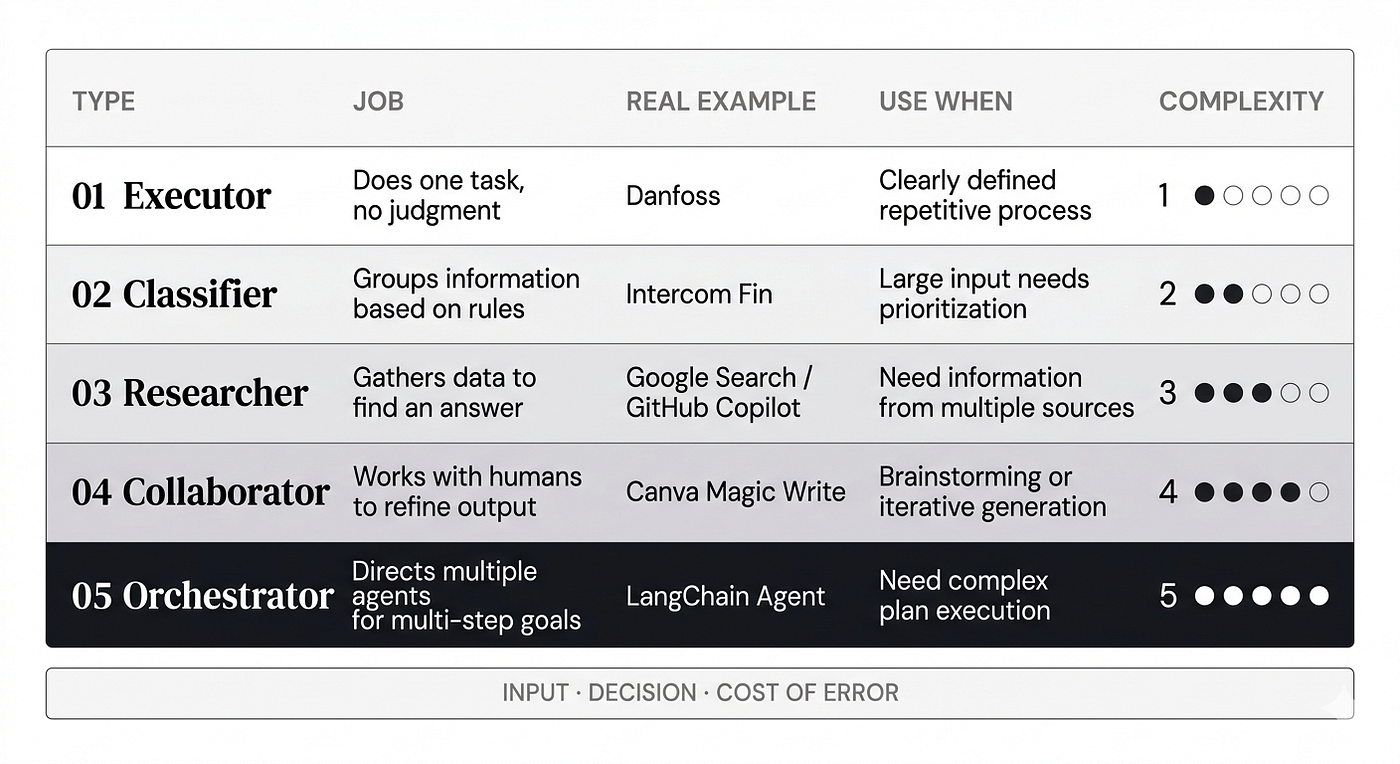
The Executor
Does one job, end to end, every time. No judgment required. You define the trigger, the steps, the output. The agent runs it.
The Classifier
Reads something, puts it in a bucket. Support ticket → priority. Inbound lead → fit score. Contract → risk category. The AI’s job is judgment on a bounded decision space.
The Researcher
Given a goal, it goes and finds things. Scans sources, pulls data, compiles what’s relevant, and surfaces a summary. The human still decides, but with far less grunt work.
The Collaborator
Works alongside a human in real time. Suggests, drafts, flags, but the human decides and acts. The agent accelerates. The human steers.
The Orchestrator
Manages other agents. Breaks a goal into subtasks, delegates to specialized agents, monitors progress, handles failures, and consolidates results. This is the most architecturally complex type, and the most overhyped for companies that don’t need it yet.
The 3-Question Filter
Before you pick a type, answer these three questions honestly:
What is the input? Is it structured or unstructured? Predictable or variable? A clean webhook vs. a messy email thread requires very different agents.
What decision is being made? Does the agent choose from known categories, or reason about something open-ended? Bounded decisions → Classifier. Open-ended reasoning → Researcher or Collaborator.
What’s the cost of a wrong answer? Low and recoverable → automate more aggressively. High and irreversible → keep a human in the loop. This single question determines how much autonomy you hand the agent before it acts.
Most startups and small businesses answering these questions honestly land on Type 1 or Type 2. That’s not a limitation, that’s clarity. Gartner predicts 40% of enterprise apps will feature task-specific AI agents by 2026, up from less than 5% in 2025. Task-specific is the operative phrase.
The Mistake Everyone Makes
They hear “AI agent” and imagine Type 5. The autonomous system that handles everything, coordinates everything, decides everything.
Then they build toward it without proving Types 1 through 4 first. They end up with an Orchestrator managing agents that don’t work, coordinating workflows that were never properly defined.
The teams getting real results, including Danfoss, TELUS, and Intercom, didn’t start with orchestration. They started with one well-defined job. They proved it worked. Then they expanded.
Pick the type that matches your problem. Prove the loop. Then go further. The complexity isn’t the goal. The outcome is.
Need context on how agents fit into a broader AI plan? Start with what an AI strategy actually is. Already using no-code tools and wondering if AI can do more? Read why Zapier may not be enough for the automation you’re after.
Want to apply this to your business? Explore AI Automation Consulting →
Get the next one in your inbox
One practical AI idea per week, from real client projects. No fluff, unsubscribe anytime.