How to Turn Your Method Into an AI Product
Why Your AI Needs an Ontology, Explained Without the Jargon
By Amin Rabinia · Founder, Glissando AI
You have a method. It might be a framework your clients pay you for, the standard operating procedures your team follows, a workflow nobody else in your industry quite matches, or a business knowledge base built over years. It took you a long time to build, and it works.
Now you want an AI product built on it: a tool that applies your process at scale, an assistant that makes your calls when you're not in the room, an agent that handles the work your way. The obvious first step is to give your material to an AI. Upload the documents, paste in the notes, write a long prompt, and ask it to work like you.
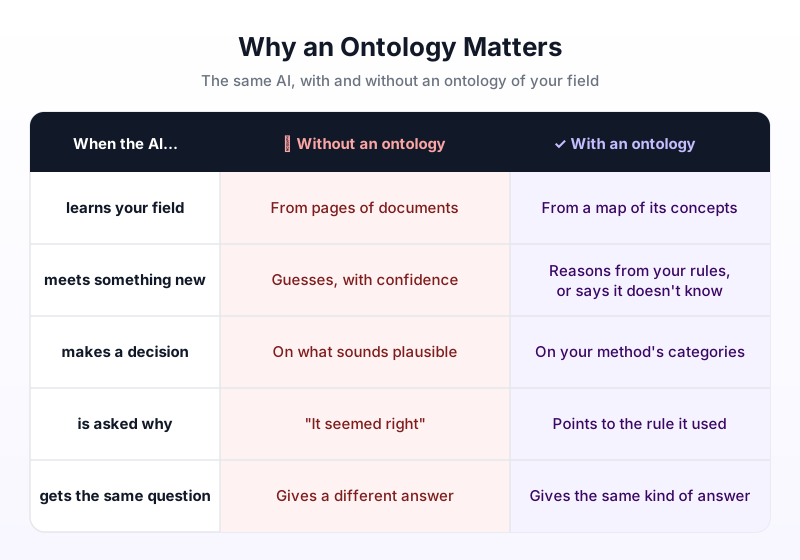
For a while, it will. Then it meets a situation your material doesn't cover word for word, and it decides what to do on its own. It picks an answer that sounds plausible, states it with full confidence, and nothing in the system tells it, or you, that it just guessed.
That moment, when the AI stops following your judgment and starts making its own, is what an ontology exists to prevent. It's what this post is about.
An AI left to itself fills every gap by deciding
A language model has read more about your field than you ever will. It knows the vocabulary, the common advice and the standard frameworks. What it doesn't have is your meaning: what you mean by each of those words, how your concepts relate to each other, which situations call for which response, and where your approach stops applying.
So when it reaches the edge of what you gave it, it doesn't stop. It fills the gap with the most plausible thing it knows, which in most fields is the average of everything ever written about the topic. Sometimes that is harmless. Sometimes it is a made-up fact, a rule your business never had, or a decision you would never have made, delivered in the same confident tone as everything else. That is what people mean by hallucination, and it is the AI deciding instead of you.
The result is an AI product you can't fully trust. Ask it the same question twice and you get two different answers. Ask it something slightly outside your examples and it improvises. Ask it why it said something and it can't point to anything firmer than "it seemed right". For a product carrying your name and your clients' decisions, that is the real risk.
Why uploading your documents isn't enough
Uploading your material gives the AI your text. It doesn't give it your structure.
Your documents were written for people, who read them in order, hold the whole picture in their head and fill the gaps with judgment built over years. An AI working from uploaded documents doesn't read them that way. It searches them, pulls out the few passages that look most related to the question, and answers from those. It never sees how one part of your method depends on another, which ideas are the foundation and which are examples, or that two passages that seem to contradict each other apply to different situations.
Without that structure, your knowledge is a pile of notes, and the model inherits the mess. Where the notes are clear it follows them; everywhere else it decides for itself.
The natural next move is to add rules: always do this, never say that, follow these steps. That makes things worse in a different way. Rules make an AI rigid. It follows them where they don't fit, breaks them where they weren't written, and loses the judgment that made it worth using. You end up maintaining a growing list of exceptions, which is a sign the foundation is missing.
What an ontology is, in plain words
An ontology is a map of your field: what exists in it, what each thing is, how the things relate, and where the field ends. Not a list of facts, and not a list of rules. A structure of meaning.
If your method is a hiring approach, an ontology says what an assessment of a candidate is made of in your terms, what kinds of gap a candidate can have and how they differ, which next step belongs to which kind, and what the interviewer is trying to learn at each point. If your method is a financial planning process, it says what every plan has in common, how its decisions depend on each other, and what counts as a finished plan.
The important part is the boundaries. People reason with categories that have clear edges: we decide what kind of thing we're looking at, then act on what that kind requires. Language models don't naturally work that way. They see everything as somewhat similar to everything else, which makes them fluent and flexible, and leaves them nothing firm to argue from.
Give a model clear categories, each with a definition and a boundary, and it can do what a good practitioner does: decide which situation it's in, act on it, and explain why. "I treated this as a skills gap, not an experience gap, because the candidate has done this work before, just not with these tools." That sentence is the difference between an AI that sounds like your method and one that applies it.
It also gives the AI a way to know what it doesn't know. When a situation falls outside every category in your field, the right answer is to say so, not to invent one. That boundary is the built-in safeguard: the AI works inside your field and recognizes when it has stepped out of it. And it doesn't make the model rigid. It still uses judgment; it just has something solid to use its judgment on.
Three layers, from what your field is to what your product does
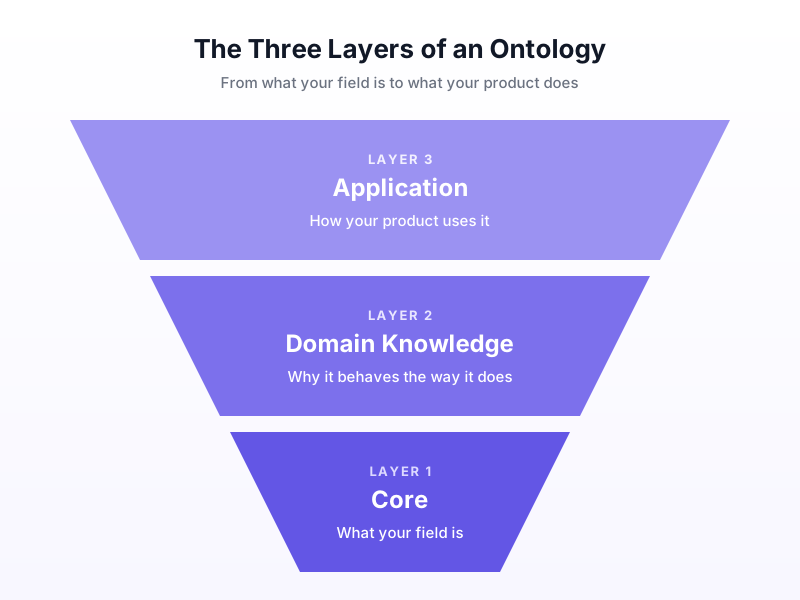
The way I build this, the knowledge comes in three layers, each answering a different question, with the core as the foundation the other two stand on (the picture at the top of this post):
- The core: what your field is. The concepts, how they relate, and where the field ends, defined independently of any one product, so it stays true however the product changes.
- Domain knowledge: what is known about it. The research, evidence and experience your method stands on, organized so the AI can tell established knowledge from opinion.
- Application: what your product does with it. How this particular product uses the core and the knowledge to serve its users.
The separation matters because the layers change at different speeds. Your product will change many times. The way your field works changes rarely. Keeping them apart means a new product, or a new version, doesn't mean starting your knowledge over.
Ontology, knowledge graph, harness: what's the difference?
If you've been reading about AI lately, you've met a few terms that sound related. They are, but they answer different questions.
The harness is how the AI works. The current shorthand in the field is agent = model + harness: the harness is everything around the model that lets it act. The loop it runs in, the tools it can use, its memory, how it manages what goes into each prompt, and how its work gets checked. A good harness makes an AI capable and reliable.
The ontology is what the AI understands. The harness decides when knowledge goes into the prompt. The ontology decides what knowledge is worth putting there, and how it fits together. A capable harness with no ontology is a well-equipped agent that doesn't understand your business: it can do a lot, quickly, and it makes its own calls wherever your knowledge is missing.
A knowledge graph holds the specifics. If the ontology says what a candidate, a role and a skill are, the knowledge graph records this candidate, this role, these skills. The ontology is the structure; the graph is filled in with real records.
A semantic layer describes data you already have. Large companies are building these so AI agents can query their databases correctly, and the big data platforms now generate them automatically from a company's existing records. That's useful, and it's descriptive: it maps what's already stored.
What a founder with a method needs is the other direction. Your value isn't in a database waiting to be described. It's in your head and your material, and it needs to be designed into a form the AI can reason from. That is prescriptive work: deciding what the AI should understand, not cataloging what exists.
Why it's an asset, not a feature
An app does one job, ages, and eventually gets rebuilt. A well-built ontology of your field outlives it.
- It drives more than one product. The same structured knowledge can power a client-facing tool, an assessment, a training product and an internal assistant. The app is one output of the knowledge, not the knowledge itself.
- It works with any model. Models change every few months. Knowledge structured outside the model moves to the next one intact.
- It's hard to copy. A competitor can buy the same model and copy your screens. They can't copy a decade of judgment, structured.
- It's yours. You own it outright, like any other intellectual property of the business. Nobody else's product is built on it.
That's why I treat it as the foundation of a product rather than an add-on. More on that idea in why your domain knowledge matters more than the model.
Do you need one?
Not every AI product does. If your product's value is moving data from one place to another, scheduling, or answering questions from a clear set of documents, a well-built retrieval system is enough. I wrote about where that works in building a trustworthy chatbot on your own content.
You likely need one when:
- your value is judgment, not information: people pay for how you decide, not for facts they could look up;
- the answers have to be defensible, so the product must be able to say why it chose what it chose;
- consistency matters: the same situation should get the same kind of answer, every time;
- you want more than one product from your method, now or later.
If two or more of those are true, the knowledge is the product, and it deserves to be built as carefully as the code. I build it as the foundation of the product, so the AI reasons from your method from the first version.
If you want to see what your method looks like as a working product before committing to a build, that is what my free working demo is for.
This post is part of the Building with AI Guide, covering everything from the first idea to a product people use.
Related reading
- What Makes AI Products Work: Your Domain Knowledge, Not the Model
- How to Decide What AI Product to Build: The Questions to Answer Before Any Code
- How to Build a RAG Chatbot for Your Website: What It Costs and What Makes It Trustworthy
- How to Build an AI Product Without a Technical Team: Plan, Design, Then Build