AI Slop: How to Tell a Product Built With Judgment From One Built in Bulk
By Amin Rabinia · Founder, Glissando AI
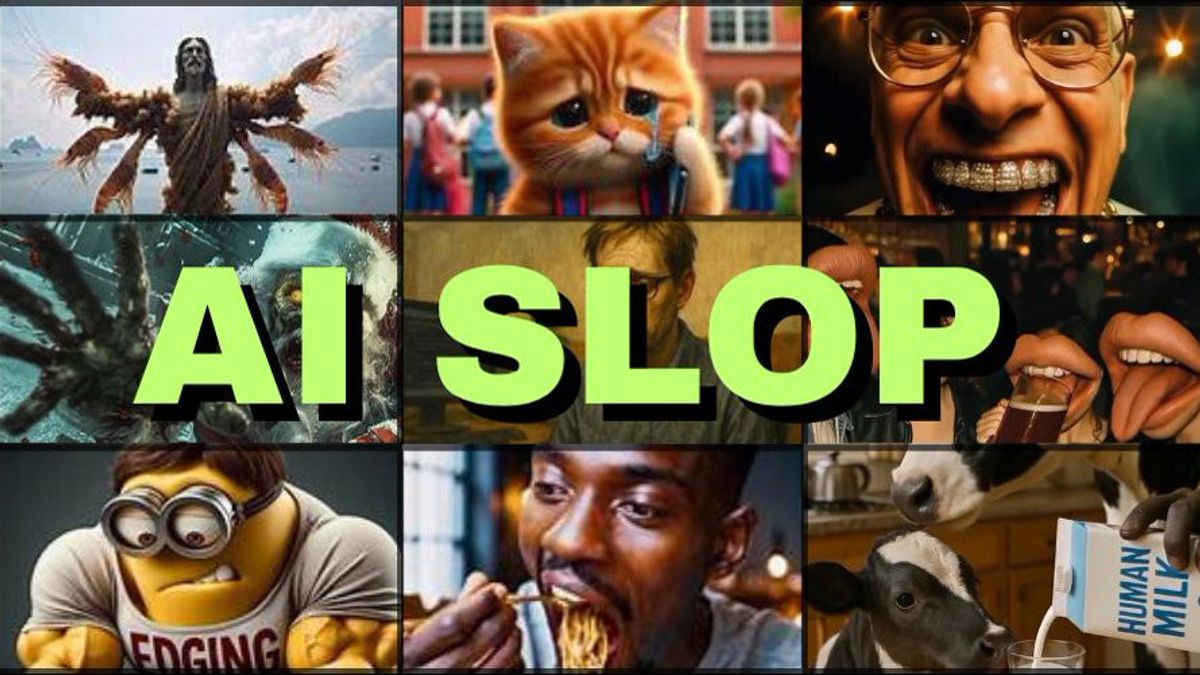
You've seen it. An AI image that's technically flawless. The lighting is perfect, the textures are crisp, the composition is clean. And yet something is wrong. You can't name it. But you feel it in the first second.
This isn't a bug. It's not going away with the next model update. And the explanation isn't technical; it's philosophical.
The Problem Has a Name Now
Merriam-Webster named "slop" its Word of the Year for 2025, defined as "digital content of low quality produced in large quantities by AI." YouTube has been inundated with lazy AI-generated footage, from pseudo-educational videos aimed at toddlers to fake movie trailers. Some channels are now explicitly labeling themselves "no AI" as a way to signal authenticity to exhausted viewers.
Shrimp Jesus, a surreal AI-generated image of Jesus formed from shrimp, became probably the best-known symbol of AI slop. It went viral not because it was convincing but because it was bizarre in a very specific way. Too detailed. Too smooth. Wrong in ways that are hard to articulate.
That wrongness is what I want to explain.
A Philosopher Saw This Coming in 1999
Paul Feyerabend was an Austrian philosopher of science who spent his career arguing against one idea: that our theories of reality are reality.

In Conquest of Abundance, his final book, he made a simple but radical claim: "reality is always larger than any model we build to describe it." Science is not wrong. It's just a slice. A useful, powerful slice. But no matter how precise your theory gets, reality keeps exceeding it. It's infinite. Models are not.
He wasn't talking about AI. The book came out the year he died. But he was describing exactly what's happening with every AI-generated image you've ever spotted as fake.
The Model Is a Slice
A generative AI model is trained on data. Enormous amounts of it: billions of images, videos, text descriptions. But even billions of images is a fraction of the visual reality that has ever existed.
What was never photographed doesn't exist inside the model. The specific quality of afternoon light in a particular village in Portugal in 1987. The way your grandmother's kitchen smelled and what it looked like at 6am. The ten thousand micro-variations in how a specific person laughs.
None of that is in the training data. It was never captured. So the model has no access to it. It works only with what humans chose to document, upload, and label, which is itself already a heavily filtered, culturally biased, incomplete record of reality.
Feyerabend would call this obvious. Every model of reality leaves most of reality out. That's what makes it a model.
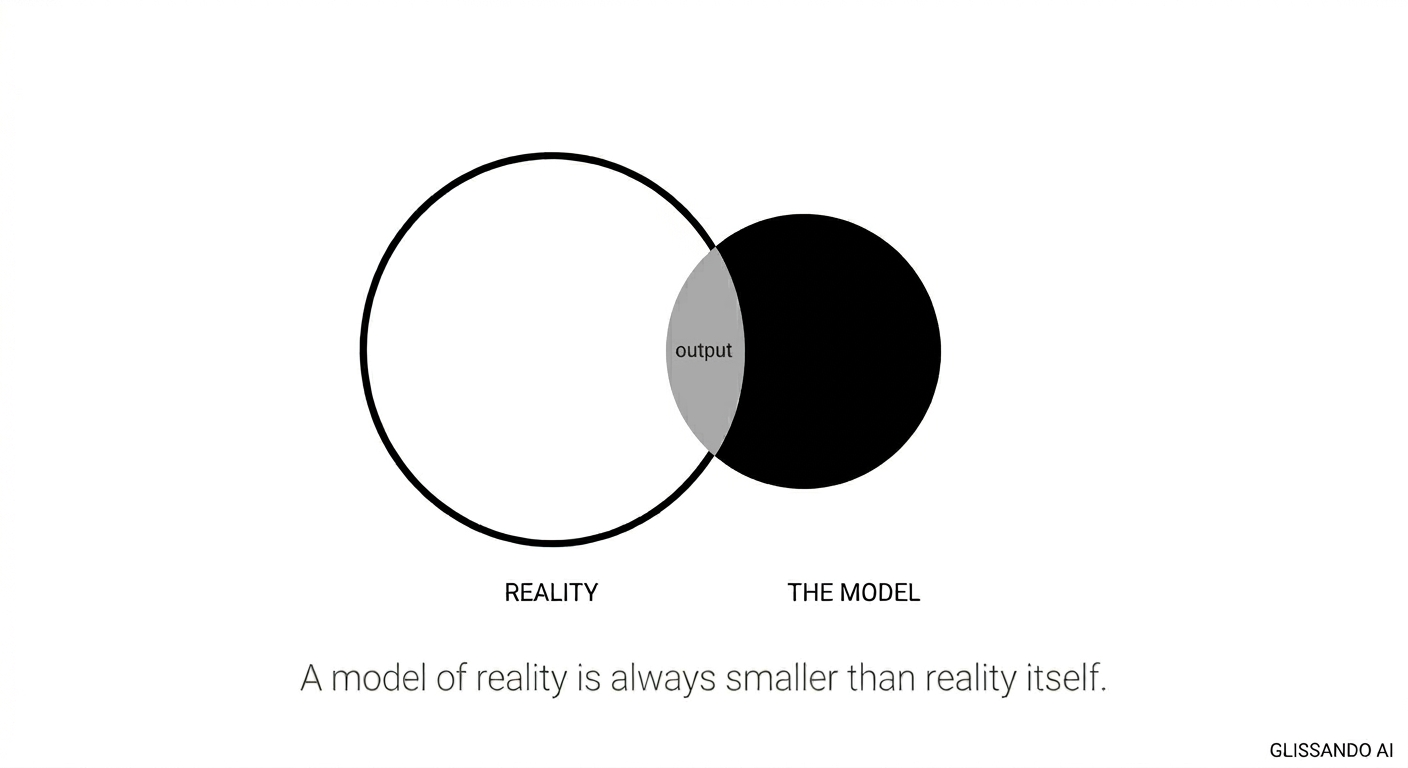
The output lives only in the overlap. Reality is always bigger than the model.
The Prompt Is Also a Slice
Now add a second problem. When you generate an image, you guide it with a prompt. A sentence or two. Maybe a paragraph if you're thorough.
"A cozy coffee shop in Paris on a rainy morning, warm lighting, film grain."

This is what that prompt generates. Beautiful. And instantly recognizable as not real.
That description points at something real, or something you imagine as real. But the description itself is a tiny fragment of what you actually mean. You have a feeling, a memory, a specific vision. The prompt captures maybe 5% of it. The rest stays in your head.
So you have a model that only knows a fraction of reality, being guided by a prompt that only expresses a fraction of your intent.
Both the source and the guide are limited. The output can't be anything other than limited too.
Generation Is Averaging, Not Perceiving
Here's what actually happens when you hit generate.
The model doesn't see. It doesn't perceive. It finds the statistical center, the weighted average of everything it has seen that resembles what your prompt seems to be asking for. It produces the most likely version of your request, given its training.
That's genuinely impressive engineering. But "most likely" and "real" are not the same thing.
Real things are specific. They have history, accident, particularity. The coffee cup on your desk has a chip on the rim from when you dropped it in 2019. The light coming through your window is slightly different today than yesterday. Real is full of irreducible detail that has no average.
Averages are smooth. Averages are generic. Averages are what AI generates, and we feel that the moment we look.
When you look closely at AI-generated content, you find inconsistencies: textures that are flat when they shouldn't be, patterns that are too perfect, or details that are inexplicably off. Shadows don't fall naturally. Lines don't follow perspective correctly. These aren't random errors. They're the fingerprints of averaging. The model produced what was statistically expected, not what was physically real.
This Is Structural, Not Fixable
The natural response is: better models, more data. And that will help. Images have gotten dramatically more convincing in two years. Video is catching up fast.
But Feyerabend's point holds at any scale. More training data is still finite training data. A more detailed prompt is still an incomplete description of intent. The gap between model and reality doesn't close; it just gets smaller.
As of March 2026, NewsGuard had identified over 3,000 AI content farm sites, with numbers more than doubling over the previous year. The volume is increasing while the gap remains. We're getting more slop, not less fake-feeling slop.
The only way to close the gap completely would be infinite training data and a perfectly complete description of intent. Neither is possible. So the uncanny valley isn't a temporary phase on the way to perfect AI realism. It's a permanent feature of how these systems work.
Why This Matters If You're Building an AI Product
Slop isn't only an image problem. Any AI product can produce it: the chatbot that answers in fluent generalities, the report generator whose summaries could describe any company, the recommendation engine that suggests the obvious. It is the same mechanism every time. The model returns the statistical average, and nothing in the product pulls it back toward your specific reality.
I saw this directly when I rebuilt the assistant on this website. Asked what an MVP costs, with no access to my actual prices, the models invented "$10,000 to $50,000" and "$15k-$100k". Fluent, plausible, and wrong for this business. That is slop in its most expensive form: an average answer presented as a specific one, in front of a prospect.
So the useful question for a founder isn't "will this AI produce slop?" It will, if left alone. The question is: what has the builder put between the model and your customer to close the gap?
How to Tell a Product Built With Judgment From One Built in Bulk
The gap between model and reality can't be closed completely. But it can be narrowed a long way, and the products that do it share four things. Use them as questions when you evaluate a builder or a prototype.
1. Is your domain written down in a form the system uses?
The prompt captures a small slice of what you mean. The rest lives in your head, or in your team's. Products that work take that tacit knowledge and make it explicit: a structured vocabulary of what things mean in your domain. On the IQ Design platform, words like "cozy" or "Scandinavian" meant something different to every designer until we built a design taxonomy that defined them. After that, the system applied them the same way across thousands of photos and products. More on this in what makes AI products work.
2. Is it grounded in your real material?
An assistant that answers from your actual content can't invent a price that isn't published. When I grounded the website assistant in the site itself, the invented price ranges stopped, and I also had to tell it explicitly that "the site doesn't cover this" is a correct answer. It went from declining correctly 2 times out of 6 to 5 out of 6. A product that admits a miss is more useful than one that always answers. The full story is in how to build a RAG chatbot for your website.
3. Is there a definition of correct, and is it measured?
Slop is silent. Nothing crashes when a model writes a confident answer on top of the wrong material. The only way to know is to measure, which is why I write the test set before the code. On the website assistant, accuracy at finding the right passage went from 62% to 83% with no change of model, purely from how the content was organized, and I only knew because it was measured. For the method, see the AI evaluation framework.
4. Where does a human stay in the loop?
Some judgments should stay with people. On the automated YouTube content engine, quality is held up by sample testing, reviewing the lowest-performing videos, and well-structured prompt systems with backups and checks. On a lead-scoring build, the agent scores and disqualifies, and a person always handles the close. A builder who can tell you exactly where that line sits has thought about slop. One who says the AI handles everything hasn't.
The Map Is Not the Territory
The images that fool us most are the ones that aren't trying to be realistic. The ones that feel most fake are reaching hardest for the real: a portrait, a news photo, a scene from everyday life. Products work the same way. The closer an AI product gets to your customers' real decisions, the more the averaging shows, and the more the structure, grounding and judgment behind it matter.
Feyerabend spent his career arguing that our maps are not the territory. AI is the most sophisticated map-drawing machine ever built. Building a good AI product means supplying the part of the territory the model never saw, and that part is usually your expertise. If you're planning a build, start with how to build an AI product without a technical team.
If you'd like to see whether the core of your idea holds up on your own real data, that's what my free working demo is for.
Amin Rabinia is the founder of Glissando AI. He holds an MA in Philosophy and an MS in Computer Science.
This post is part of the Building with AI Guide, covering everything from the first idea to a product people use.
Related reading
- What Makes AI Products Work: Your Domain Knowledge, Not the Model
- How to Build a RAG Chatbot for Your Website: What It Costs and What Makes It Trustworthy
- AI Evaluation Framework: A Risk Matrix Beyond Hallucination and Bias
- How to Build an AI Product Without a Technical Team: Plan, Design, Then Build