How to Show Up in ChatGPT, Gemini, and Google AI Search
By Amin Rabinia · Founder, Glissando AI
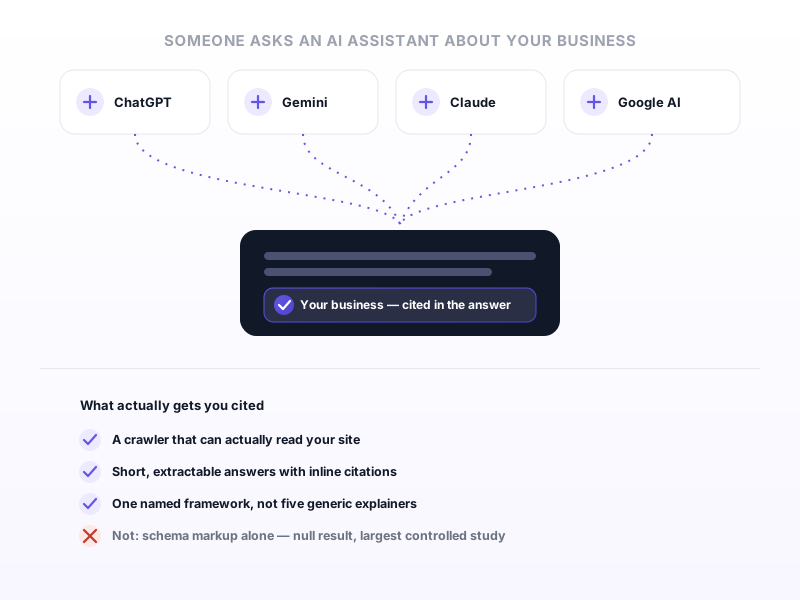
Before we sold generative engine optimization as a service, we ran the experiment on ourselves. We fetched our own site as GPTBot, pulled three months of Google and Bing/Copilot data side by side, and checked which of our pages actually gets quoted back when someone asks ChatGPT, Gemini, Claude, or Google AI a question in our space. Some of what we found matched the emerging conventional wisdom on GEO. Most of it didn't, and most of it is directly actionable, not theory.
That gap is the reason for this post. A lot of GEO content published right now tells you to add a plugin or a stat that comes from a study whose own authors say it doesn't mean what it's being used to mean. We'll get to that. But first, what actually worked on our own site, because it's the part nobody has to take on faith.
llms.txt file. The two things with real evidence behind them are extractable content (short, direct, well-structured answers a model can lift cleanly) and inline citations to sources a model already trusts. On our own site, the page that gets cited most isn't a landing page; it's a blog post built around one named framework.What We Found Fetching Our Own Site as GPTBot
The first question in any GEO audit is mechanical, not strategic: can the crawler actually read the page? We fetched glissando.ai as GPTBot and confirmed the pages are server-rendered HTML with zero JavaScript dependency. The content a browser shows a human is exactly what GPTBot receives, with no client-side rendering step in between where a crawler might give up early. Each page carried 1,300–1,750 visible words, well past the point where an extraction model has enough surrounding context to summarize accurately.
That's the table-stakes half of GEO, and it's genuinely table stakes. If your site depends on client-side rendering to show its actual content, no amount of framework-naming or citation-building matters, because the crawler never sees the words in the first place. If you haven't checked this on your own site, a GEO audit starts exactly here, before anything more interesting.
The Stat You've Probably Seen, and Why We're Not Using It
"Adding schema markup increases AI visibility by 40%" is showing up in a lot of GEO content this year, usually cited without a link to the actual study. We went and read it. The 40% number comes from a test that held retrieval constant, meaning the researchers controlled for whether a page got retrieved at all, then measured something else. It is not evidence that schema markup makes a page more likely to be retrieved and cited in the first place, which is the entire question a business owner actually has. In the largest controlled study on GEO to date, schema markup produced a null result on that question.
We're calling this out directly because repeating a rejected stat is worse than saying nothing. It gives a business owner a to-do list item ("add schema markup") that costs a developer's afternoon and moves nothing. The same goes for llms.txt, a proposed standard for telling AI crawlers what to prioritize on your site. It's a reasonable idea. No major AI provider has committed to actually honoring it. Adding one costs nothing and might matter eventually; treating it as a fix today is optimism, not strategy.
What does have real evidence behind it, from the same body of research: extractable content (answers that are short, direct, and structurally separable from the surrounding page, the opposite of a paragraph that requires the three before it for context) and inline citations to sources the model already trusts. Both of those are things you write, not things you configure. That's a less satisfying answer than a plugin, and it's the accurate one.
The Channel Data Nobody Expects
Here's the surprising part from our own numbers, and the one we didn't expect going in: Google sent us roughly 13 times the impressions Bing/Copilot did over the same three months, and almost none of it converted into a non-brand click. Bing/Copilot's much smaller volume produced the majority of our actual non-brand clicks. Bing feeds Copilot, which feeds a meaningful share of ChatGPT's search results, so a channel we used to treat as an afterthought turned out to convert roughly 70 times better per impression than the channel we'd been optimizing for by default. Claude and Gemini pull from their own separate retrieval paths, which is exactly why "check Google Search Console" was never going to answer whether any of them cite you.
That's not a reason to abandon Google. It's a reason to stop assuming Google traffic and AI-citation traffic are the same optimization problem wearing two names. They're not. A page can rank fine on Google and never get quoted by an AI assistant, and vice versa, which is exactly what our own site's data showed.
The Page That Actually Gets Cited
The single most useful finding, and the one that should change how you prioritize: our best-performing page for AI citation isn't a landing page. It's a blog post, the 4 Pillars of AI Strategy, earning roughly 40% of all our non-brand clicks at an average position of 3.7. Not a coincidence. It's a nameable structure: vision, value, risk, adoption. A model can retrieve that framework, quote its four parts, and attribute it to us, because it's a self-contained thing with a name, not a generic explainer that blends into everything else already written on the topic.
We've since applied the same pattern deliberately: SORTIE, our AI risk taxonomy from a real evaluation-strategy engagement, and the RFQ Engine's four-stage model (Parse → Match → Price → Rank) both follow the identical logic. Given a choice between publishing one named framework or five generic explainers on the same topic, we now always pick the framework. It's not just easier to remember: it's structurally easier for a retrieval system to lift cleanly and attribute correctly.
What Actually Moves the Needle, in Order
If you're deciding where to spend an afternoon on this, here's the order that matches the evidence rather than the hype cycle:
- Confirm the crawler can read you at all. Fetch your own site as GPTBot (or check server logs for its user agent). If your content depends on client-side JavaScript to render, fix that before anything else. It is a hard gate, not a ranking factor.
- Write extractable answers. Short, direct, structurally separable. Each paragraph should answer one question fully, without needing the three before it.
- Cite sources a model already trusts. Inline citations to primary research, not just internal links, is one of the two things with actual controlled-study evidence behind it.
- Name your frameworks. A structure with a name is a unit an engine can retrieve and quote as a whole. A generic explainer is competing against every other generic explainer on the same topic.
- Measure Bing/Copilot separately from Google. If you're only watching Google Search Console, you're missing the channel that, on our own data, converts far better per impression.
What we'd skip, at least for now: schema markup as a citation strategy (null result), and llms.txt as anything more than a low-cost bet on a standard that hasn't been adopted yet.
What This Means for You
GEO isn't a plugin you install or a meta tag you add. The evidence, both the published research and our own site's numbers, points at two things that are actually writing decisions: make your best answers extractable, and give your best ideas names. Everything else being sold as a GEO checklist right now is either unproven or unadopted.
If you want the full audit, including what GPTBot actually sees on your site, where you stand on Bing/Copilot versus Google, and which of your pages could become the next named framework, Get Expert Input and we'll walk through your own numbers the way we walked through ours.
A GEO audit checks whether GPTBot can actually read your site, where you stand on Bing/Copilot versus Google, and which of your pages is closest to becoming the next named, citable framework.
Get a GEO Audit →This post is part of the AI Strategy Guide, covering everything we've written on planning AI work, organized by subtopic.
Related reading
Get the next one in your inbox
One practical AI idea per week, from real client projects. No fluff, unsubscribe anytime.