How Many AI Agents Does Your Product Actually Need?
By Amin Rabinia · Founder, Glissando AI
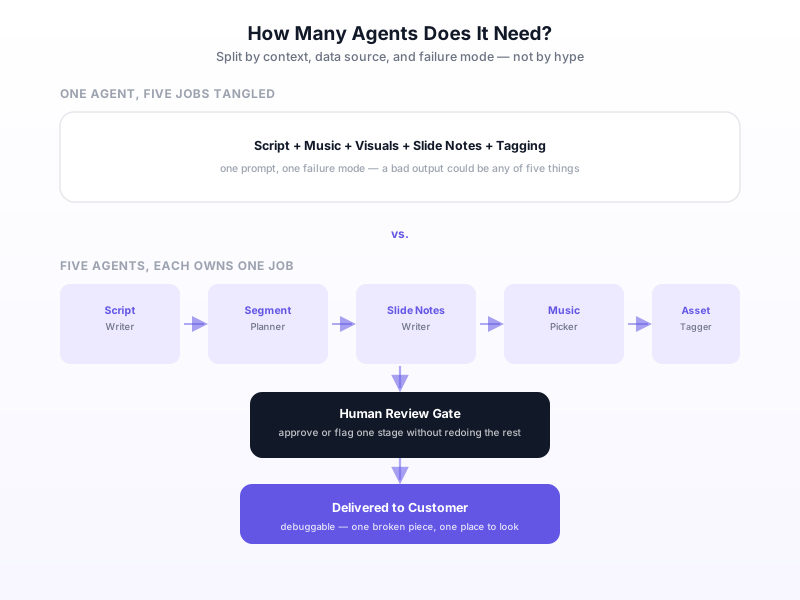
"Multi-agent" has become one of those terms founders hear a lot and can't quite evaluate. Does your product need one agent or ten? Is more agents better, or is that just complexity dressed up as sophistication? The honest answer is that agent count isn't a target to hit, it's a byproduct of a much narrower decision: does this step need its own context, its own data source, or its own way of failing? If yes, it's a separate agent. If no, it belongs inside the one you already have.
We can make that concrete with a real build. Honored Memory and Loyal Memory, two live AI video products we built, run five cooperating agents per video: a Script Writer, a Visual Segment Planner, a Slide Notes Writer, a Music Picker, and an Asset Tagger. Five wasn't a number we picked in advance. It's what the actual pipeline needed once we asked the split question honestly at each step.
The Real Decision Rule: Context, Data, Failure Mode
The question to ask isn't "should this be its own agent" in the abstract; it's whether the step in front of you needs a genuinely different context window, a different data source, or has a different way of going wrong than the step before it. A single agent that writes a script, picks music, and plans visuals all in one prompt is dragging three different jobs, and three different failure modes, into one undifferentiated blast radius. When it goes wrong, you don't know which part broke.
Compare that to the tribute-video pipeline: the Script Writer works from the customer's photos and a few sentences about the person being honored. That's its entire context. The Music Picker works from a mood tag the Script Writer produces, a completely different, much smaller context, with its own separate way of failing (matching the wrong track to the wrong mood is a different bug than writing a tone-deaf script). Keeping those two jobs apart means a bad music pick never corrupts the script, and a script rewrite never has to touch the music logic at all.
What Owning One Job End to End Actually Buys You
Each agent in that build owns one job from input to output. The Script Writer never touches music, and the Music Picker never touches visuals. That's not a purity rule for its own sake. It's what let a human reviewer approve or reject a single stage without redoing the whole pipeline, and what made the system debuggable in a very concrete way: when a video came out wrong, we knew exactly which agent to look at instead of untangling one giant prompt trying to explain five decisions at once.
That debuggability compounds over time. A system built as one large prompt gets harder to change the more it does, because every edit risks breaking behavior you didn't mean to touch. A system split by genuine job boundaries stays editable: you can improve the Music Picker's taste without touching the Script Writer's tone, because they were never tangled together in the first place. This is the same principle behind an agent that completes a full workflow instead of one flashy step: the value is in the handoffs being clean, not in any single step being clever.
The Failure Mode of Too Few Agents
The most common mistake isn't building too many agents. It's building one agent and asking it to do everything, because splitting the work feels like unnecessary architecture up front. In practice, that single agent ends up implicitly doing five jobs inside one prompt, with no clean seam between them. When something goes wrong, there's no single place to look. You're debugging a script, a music choice, and a visual plan all tangled into one output, and fixing one risks silently changing the others.
This is a version of the same lesson from what actually makes AI products work: structure beats cleverness. A taxonomy, a pipeline stage boundary, an agent split: these aren't the exciting part of an AI build, but they're consistently the difference between a system that's still improvable a year in and one that's calcified around its own first version because nobody can safely touch it anymore.
The Failure Mode of Too Many Agents
The opposite mistake is real too, and it's the one "multi-agent" hype actively encourages: splitting work into agents that don't have a genuinely different context, data source, or failure mode from their neighbor, just because more agents looks more sophisticated in an architecture diagram. That adds coordination overhead, with more handoffs and more places for information to get lost between steps, without buying you any of the real benefits of separation.
The test is simple: if two proposed agents would always succeed or fail together, on the same input, for the same reason, they're not actually separate jobs. They're one job you split for appearances. Collapse them. The tribute-video pipeline didn't split the Slide Notes Writer from the Script Writer because five sounds better than four; it split them because the opening and closing card copy has a different job (framing the whole video) than the narration script does (carrying the story), and they can be wrong independently of each other.
Where the Human Still Belongs
None of this argues for full automation as the goal. In the tribute-video build, every video still gets a human review before a customer sees it, regardless of how well the five agents perform individually. Splitting work cleanly by job doesn't mean removing judgment from the loop. It means making the judgment easier to apply, because a reviewer can approve or flag one stage's output without having to untangle it from four other decisions first.
That's worth sitting with before any multi-agent build: the goal isn't the most agents, or the fewest. It's a pipeline where each seam lines up with a real difference in context, data, or failure mode, so that both the system and the humans reviewing it can reason about one job at a time. See the full architecture in the AI Video Generation SaaS case study, or read more about how we scope agent boundaries in AI agent development.
If you're scoping an agentic build and aren't sure where the real seams are, that's exactly the conversation worth having before any code gets written. Get Expert Input, a paid session where we look at your actual workflow and tell you honestly where it should split into separate agents and where it shouldn't.
This post is part of the AI Agents Guide, from the basics to the technical depth behind agents that actually work.
Related reading
Get the next one in your inbox
One practical AI idea per week, from real client projects. No fluff, unsubscribe anytime.