How to Build a White Label AI SaaS Product on One Codebase
By Amin Rabinia · Founder, Glissando AI
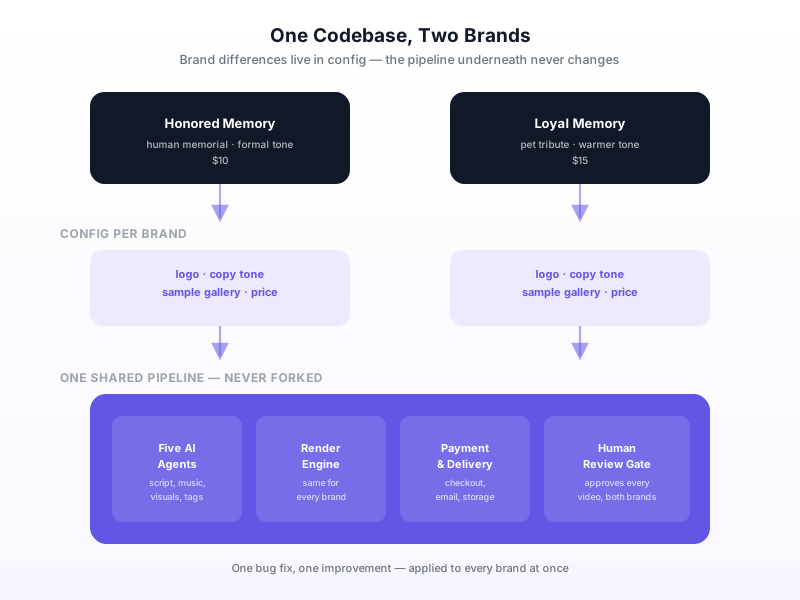
Founders asking about white-labeling usually assume the answer requires either forking the codebase for every new brand or building some kind of heavyweight multi-tenant platform before they've even validated one product. Neither is true for most AI SaaS products. The real requirement is much narrower: everything that makes a brand feel like its own product, including logo, copy tone, sample gallery, and price point, has to live in configuration, not in code. If it does, launching a second brand is a content exercise. If it doesn't, it's a second engineering project wearing a different logo.
We run this pattern live, not theoretically. Honored Memory and Loyal Memory are two AI video products, one for human memorials and one for pet tributes, that share every line of pipeline code: the same rendering engine, the same five AI agents, the same payment flow, the same delivery system. What's different between them lives in one config file per brand.
What Actually Has to Be Config, Not Code
The test for whether something belongs in a config file is simple: would a different brand plausibly want a different value here, without needing different logic to handle it? A logo is config, since swapping it never changes how the rendering pipeline behaves. A price point is config, since $10 versus $15 doesn't touch the payment integration, it's a number the checkout flow reads. Copy tone, sample gallery images, the mood of the marketing site, all config, because none of it changes what the product actually does, only how it presents itself.
What stays in code is the part that would break if you tried to make it brand-specific: the rendering engine, the agent pipeline, the data model, the async job architecture. Those are the same regardless of which brand a customer lands on, because the underlying job, turning photos and a few sentences into a narrated, music-scored video, doesn't change. A pet tribute and a human memorial ask the same five agents to do the same five jobs; only the tone of what they produce shifts, and tone is exactly the kind of thing a config file can carry.
Why This Is Harder Than It Sounds in Practice
The difficulty isn't technical; it's discipline. The moment a second brand needs something the first brand's config can't express, there's a strong temptation to just branch the code for that one brand "for now." That's the fork waiting to happen. Every one of those small exceptions is a future maintenance cost: a bug fix now has to be applied in two places, a feature improvement now has to be tested against two slightly diverged codepaths, and the promise of "one codebase, multiple brands" quietly stops being true.
The discipline that keeps this from happening is treating every brand-specific request as a config question first: can this actually be expressed as a value in the config file, even if it takes a bit more upfront design to make the pipeline flexible enough to read it that way? That's the same instinct behind domain structure beating model choice in AI products generally. The unglamorous work of building the right abstraction up front is what saves the actual engineering effort months later, when brand three or four shows up.
What Launching a Second Brand Actually Looked Like
Launching Loyal Memory after Honored Memory was a content and config exercise, not a second engineering build. The pipeline, the agents, the payment integration, and the delivery system didn't change at all. What changed was a new config file: a new logo, pet-appropriate sample tributes, a different copy tone (warmer, less formal than a human memorial), and its own price point. No new rendering logic, no new agent, no new infrastructure. The second brand existed the same week the config was written.
That's the actual value of the pattern for a founder or agency evaluating white-labeling: the cost of brand number two, three, or four isn't proportional to the cost of brand number one. Most of the cost was already paid once, in the pipeline. Each additional brand after that is closer to a landing page and a config file than a rebuild, which is the entire economic case for building this way from the start, even if you only have one brand today.
When This Pattern Doesn't Fit
This isn't a universal argument for multi-brand from day one. If you only have one brand and no near-term plan for a second, building the config abstraction upfront is unnecessary complexity, the same lesson as the 5-phase MVP method: prove the core product works before investing in flexibility nobody's asked for yet. The config-per-brand pattern earns its cost the moment a second brand is real, not before.
It's also not the right pattern if the brands genuinely need different underlying behavior: different agents, a different pipeline shape, or a fundamentally different customer workflow. At that point you don't have one product wearing two skins, you have two products, and forcing them into one config-driven codebase creates exactly the kind of tangled exceptions the pattern is supposed to prevent. The full pipeline both Honored Memory and Loyal Memory share is documented in the AI Video Generation SaaS case study, alongside the five-agent architecture that makes the config split possible in the first place.
If you're evaluating whether your product could support a second brand without a second build, that's exactly the kind of architecture question worth getting a second opinion on before committing either way. Get Expert Input, a paid session where we look at your actual product and tell you honestly whether a config-driven multi-brand pattern fits, or whether it's premature for where you are.
This post is part of the Building with AI Guide, covering MVP scoping through architecture decisions that hold up as a product grows.
Related reading
Get the next one in your inbox
One practical AI idea per week, from real client projects. No fluff, unsubscribe anytime.