How to Build an AI MVP Without Wasting Months on the Wrong Features
By Amin Rabinia · Founder, Glissando AI
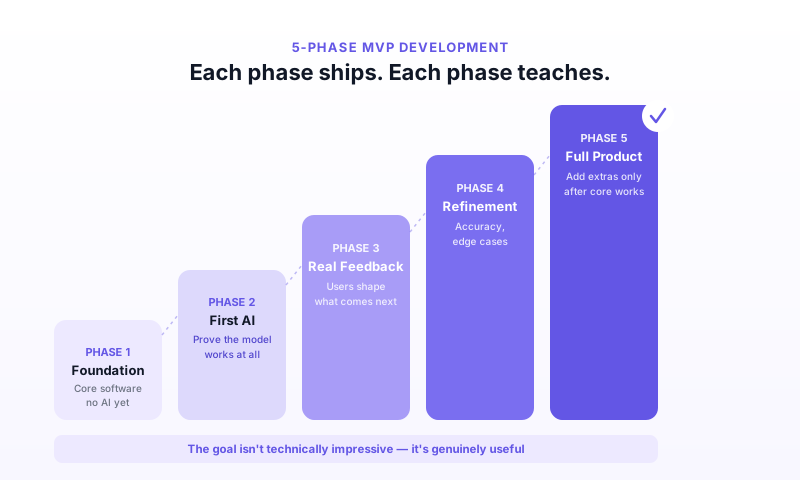
When a business owner comes to us wanting to build an AI product, they usually have a picture of the finished thing in their head. The full vision. All the features. The AI doing everything it's eventually supposed to do.
Our first job is to talk them out of trying to build that.
Not because the vision is wrong. But because trying to build the whole thing at once is the single most reliable way to end up with something technically impressive that no one actually uses.
What "Phased Development" Actually Means
The word "MVP" has been watered down. People use it to mean "a rushed version with half the features." That's not what we mean. Each phase we build is a real, working product that someone can use. It's just a narrower product — focused on proving one thing before we layer in the next.
The phases aren't a schedule. They're a sequence of questions.
Phase one asks: can we build the underlying software that makes this possible at all? Phase two asks: can the AI component do what we think it can do? Phase three asks: do real users interact with this the way we expected? Phase four asks: where does it still fall short? Phase five asks: what's the right thing to add now that we know all of the above?
You cannot answer phase five without first answering phases one through four. That's not caution — it's how you avoid building expensive features nobody wanted.
The IQ Design Case Study
IQ Design is a furniture retailer. They came to us with a specific problem: customers were describing what they wanted in emotional terms ("cozy," "modern," "the vibe of a Scandinavian cabin") while the product catalog was organized in technical ones (material, category, price). The gap between those two vocabularies was causing people to leave without finding what they were looking for.
The vision was an AI system that could take inspiration photos, understand the aesthetic, and match it to products in inventory. A visual recommendation engine. It's a compelling idea. And it's also a complicated technical problem — computer vision, semantic matching, inventory integration, user experience design.
We didn't build all of that. We built it in phases.
You can read the full breakdown on the IQ Design case study page, but here's what the phased approach looked like in practice and what each phase actually taught us.
Phase 1: Basic Software First, No AI
Before any AI touches a project, we build the underlying system that AI will eventually plug into. For IQ Design, that meant: catalog management, product tagging, a simple interface for staff to work with, and the data pipelines that would eventually feed the model.
This isn't glamorous. It's also not optional.
AI is an enhancement to a system, not a replacement for one. If the base system doesn't work — if data is messy, if the interface is confusing, if inventory integration is fragile — no model will fix that. You'll end up with a brilliant AI sitting on top of broken plumbing.
Phase one also forces a useful discipline: you have to describe what you want the system to do in plain terms before you hand it to a model. That description usually turns out to be harder than expected — which is good information to have early.
Phase 2: Prove the Model Actually Works
Phase two is where AI enters — but in the most minimal form possible. The only question we're answering is: can the model do the core thing we're asking it to do?
Not "can it do it perfectly." Not "can it do it at scale." Can it do it at all, on real data, in a way that's directionally useful?
For IQ Design, this meant testing whether a vision model could meaningfully interpret aesthetic qualities from inspiration photos and produce outputs that bore any relationship to real product categories. Early results were rough. That's expected. What mattered was whether the signal was there.
If it is, you continue. If it isn't, you've learned something critical — before investing in the rest of the build.
This is why the jump from proof of concept to MVP is a distinct step, not a blur. Phase two is the proof of concept. You're not promising anyone it works. You're finding out if it can.
Phase 3: Real Users, Real Feedback
Phase three is where the plan usually meets reality.
For IQ Design, we had originally planned to include a moodboard feature — a way for customers to pin inspiration images and let the AI build a coherent aesthetic profile over time. It seemed like a natural extension of the core idea. We were ready to build it.
Then we watched how real users actually used the product.
They didn't want to curate. They wanted to search. They came in with one photo — a room they'd seen on Instagram, a screenshot from a design magazine — and they wanted the system to immediately surface things that matched. The moodboard was adding friction to a process they wanted to be instant.
We didn't build it. That decision saved weeks and, more importantly, kept the product focused on what users actually cared about.
This is the core value of phasing: later phases are shaped by real feedback from earlier ones. You don't have to guess what users want after they've been using the product for two months — they'll tell you, directly or through their behavior.
Phase 4: Fix What Doesn't Work Yet
Once you have real usage, you have real failure modes. Phase four is about addressing them before expanding.
For IQ Design, accuracy was the main challenge in phase four. The model was getting the broad aesthetic right — a photo of a minimalist living room would surface clean-lined furniture, not ornate traditional pieces. But it was inconsistent on material and finish. A customer looking for warm wood tones was getting results that included cool metal and glass.
The answer wasn't a different model. It was a better-structured taxonomy — a vocabulary that connected what the model saw to real product attributes in a systematic way. We'll write about the taxonomy work separately because it deserves its own post. But the point for here is this: the problem only became visible after real people used the product in phase three. Without phase three, we'd never have known exactly what to fix in phase four.
This is also when you address edge cases — the unusual inputs, the products that don't fit neatly into categories, the aesthetic queries the model handles badly. You don't have to solve every edge case. But you have to know which ones are common enough to matter.
Phase 5: Add What You Actually Know Is Needed
By the time you reach phase five, your product roadmap looks completely different from what it did at the start. Not because the vision was wrong — but because you now have information you didn't have before.
You know which features users actually reached for. You know which problems turned out to be harder than expected. You know which AI capabilities worked, which ones needed scaffolding, and which ones weren't worth pursuing.
Phase five is where you add depth, optimization, and the features that require the earlier system to already be stable. It's also where you make the product significantly better than phase one in ways that feel effortless to the user — because all the hard work was already done.
For IQ Design, phase five included tighter inventory integration, performance improvements to the matching speed, and a more polished UI informed by months of watching how people actually navigated the tool.
The Rule Under All of This
Every time we've wanted to skip a phase — because the timeline felt comfortable, because a feature seemed obvious, because a client was excited about something specific — we've come back to the same principle:
Prove the core works before you build around it.
The core is the thing your product lives or dies on. For IQ Design, it was aesthetic matching. For an AI agent handling business workflows, it's the decision-making logic. For a RAG chatbot, it's the retrieval accuracy. Whatever that core thing is — prove it first. Everything else is an extra.
Extras built on top of a proven core make the product better. Extras built before the core is proven make the product expensive and fragile.
This is also why the distinction between an AI function and an AI feature matters so much in the planning stage. A function is core — the thing the product fundamentally does. A feature is additive. Phased development forces you to be clear about which is which, because you have to build the function before you have anything worth adding features to.
What This Means for You
If you're thinking about building an AI product, the most useful question to start with isn't "what should this do eventually?" It's "what is the single most important thing this needs to do — and how would we know if it's doing it?"
That's your phase one target. Everything else is phase two, three, four, or five.
The businesses that end up with AI products that actually work in production — not just in demos — are almost always the ones that resisted the temptation to build everything at once. They built something narrow, watched what happened, and let the product's own performance tell them what to build next.
Phased development isn't the cautious approach. It's the approach that produces something people actually use.
If you're at the stage of deciding what your first phase should be, we can help you scope it. Get Expert Input — a paid consulting session where we map out what phase one looks like for your specific product and where the real technical risks are.
This post is part of the Building with AI Guide — all our writing on how AI products get made, in one place.
Related reading
Get the next one in your inbox
One practical AI idea per week, from real client projects. No fluff, unsubscribe anytime.