Startup MVP Consulting: What a Fractional AI Product Team Does, Week by Week
By Amin Rabinia · Founder, Glissando AI
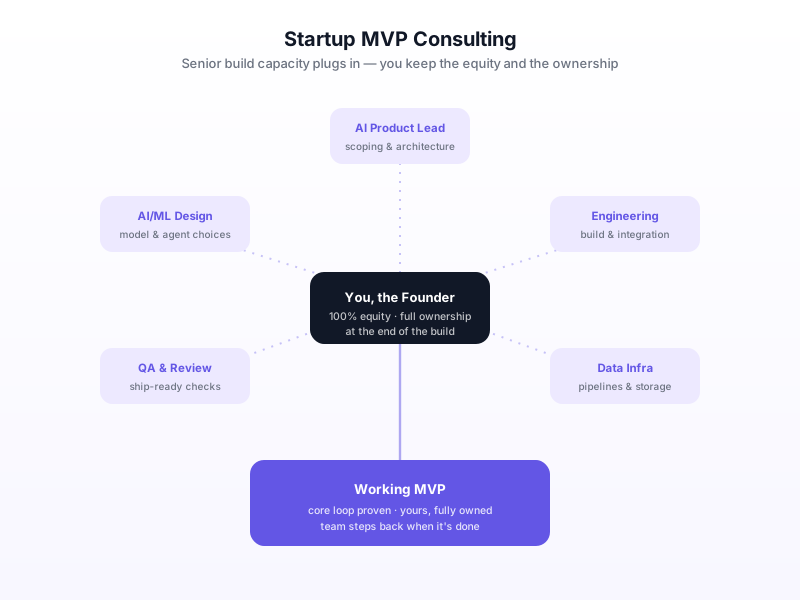
You have a real idea, maybe some early customers, and no technical team. The two options pitched hardest are hiring a full-time CTO or bringing on a technical co-founder. Both mean handing over a salary or a permanent slice of the company before you know whether the product works.
Startup MVP consulting is a third option: senior product and build capacity you bring in for exactly as long as the build needs it. "Fractional" gets used loosely, so here is what it looks like in practice, week by week.
What You Get: One Person in Three Roles
Most build teams split the work across three people who hand off to each other: someone decides what to build, someone designs it, someone builds it. The thread gets lost at every handoff. In a fractional model done well, the person deciding and the person building are the same person, so the design survives contact with the code.
- Product manager: is the market there, is the product vision clear, what does the first version have to prove?
- Product designer: what makes sense to the user, in the interface and in the market, and what doesn't.
- Engineer: the domain model, the architecture and the build itself.
For founders who are strong on the business side and have never had to judge technical work, this matters. Part of the job is translating "is this technically real" into plain terms you can evaluate, at every stage.
Week by Week: A Typical MVP Build
Every project differs, but a typical 4 to 8 week MVP follows the same three phases: discovery and scoping, design, then build and launch.
Week 1: Plan the business
Market questions before product questions. What business is being built, who pays, who uses it, and what winning looks like. This is also where we agree on the date that matters, and on what the first real users will be asked to do once the MVP is live. That validation step is written into the plan from the start, not added at the end.
Weeks 1 to 2: Design, and prove the core
I design the product around one core loop: the action a user takes to get the result they came for. Then I build a working sample of the hardest part on your real data, because that is the piece everything else depends on. If it can't be done, you find out now, for a fraction of the budget. You can start this step on its own with a free working demo.
Weeks 2 to 6: Build the MVP
Models, agents, backend and interface, built around the core loop and tested against your real data. Everything that isn't the core waits: settings, admin panels, edge-case polish, secondary features that sound good in a pitch deck. Not because they don't matter, but because none of them can be judged until the core works.
Weeks 6 to 8: Real users, then the next phase
The MVP goes in front of real users. What they do with it decides what gets built next, instead of guesses from a whiteboard. This is where the roadmap for version two gets written.
The Decision That Protects Your Budget
The single biggest thing that pushes an MVP over budget is scope creep: adding features before the core has been proven. Founders come in with every feature the product will eventually need, and want all of it in version one. It is an understandable instinct, and it is backwards for an MVP.
The IQ Design platform is the clearest example I have. Early on, the plan included a moodboard feature that sounded valuable. It was cut, more than once, in favor of strengthening the core matching engine, because that engine was the thing the product had to prove first. A good fractional partner makes that call with you, honestly, even when it's the feature you're most excited about. The full method is in the five-phase MVP post.
The result isn't a smaller product for its own sake. It's a product where the riskiest part gets tested first, cheaply, instead of last, expensively.
What You Own at the End
A working MVP and full ownership: code, models, documentation and infrastructure, yours from day one. The technical decisions are documented well enough that you are never locked into the same person to keep it running. No equity changes hands, and there is no long-term dependency unless you choose one.
When a Fractional Team Is the Right Choice, and When It Isn't
It fits when you need senior judgment and a real build now, and can't yet justify a full-time technical hire. It is not the right choice when you already have a complete spec and just need hands to type it, which a good freelancer can do for less, or when you have years of AI work ahead, which is when a full-time hire starts to make sense. I compare all three honestly in consultant vs freelancer vs in-house, and the planning side of a build is covered in how to build an AI product without a technical team.
If you are comparing builders and want a second opinion on your scope before you choose, a paid Get Expert Input session is the faster route.
This post is part of the Building with AI Guide, covering MVP scoping through delivering a product that's actually used.
Related reading
- How to Build an AI Product Without a Technical Team: Plan, Design, Then Build
- How Much Does an AI MVP Cost? $2k–$10k and 4–8 Weeks, If You Hold the Scope
- Who Should You Hire to Build AI for Your Business? Consultant vs. Freelancer vs. In-House
- What Questions Should You Ask an AI Consultant Before Hiring Them?
- MVP Estimation Tool: Calculate Your Timeline and Budget in Minutes