How Much Does an AI MVP Cost? $2k–$10k and 4–8 Weeks, If You Hold the Scope
By Amin Rabinia · Founder, Glissando AI
The short answer: an AI MVP I build costs between $2,000 and $10,000 and takes four to eight weeks. A working demo of just the hardest part costs $2,000 and takes about a week. Anything bigger than a true MVP I split into phases, starting from $10,000, each one priced on its own.
Those numbers are real, and they hold. But they only hold under one condition, and it's the one founders underestimate most. Not data prep, not the model bill, not hosting. Scope creep. Once the thing you're building stops being the smallest version that proves the idea and turns into version three, no estimate survives it. Mine included.
What Each Price Actually Buys
Here is how the money breaks down, without the sales gloss. These are the same lanes on my pricing page:
- AI Demo Build — $2,000, about a week. A running sample of the hardest part of your idea on your real data, plus an honest read on what a full build would cost. This is where to start if you've been burned before and want proof before spending more.
- AI Product MVP — $2,000 to $10,000, four to eight weeks. The first version real users can log into and use. Not a screenshot, not a clickable mockup. Something that holds up on real data.
- AI Product Build — from $10,000, in phases. When the product is the business. Each phase is a working thing you can use, show, or change direction after.
Where a project lands inside the $2k–$10k range depends on a few honest things: how messy your data is, whether the AI step is a well-understood task or something nobody has done quite this way before, and how many other systems it has to talk to. You own all of it from day one, and the only running costs are your own hosting and AI usage, which I size with you up front.
If you've seen agency quotes of $50,000 and up for something that sounds similar, the gap usually isn't the AI. It's the team structure around it, and very often it's scope. A quote that big is usually pricing version three.
The #1 Thing Founders Underestimate: Scope Creep
Scope creep rarely looks like a mistake while it's happening. Every addition sounds reasonable on its own. An admin panel so you can see what users are doing. A dashboard for the numbers. An integration with the CRM so nobody has to export a spreadsheet. A nicer interface, because the first one looks plain. Full automation, so nobody has to review anything.
Each of those is a real feature, and some of them will matter eventually. But none of them answers the question an MVP exists to answer: does the core idea work for a real user? They make the product bigger without making it more proven. And in AI products, every extra piece also needs its own testing on real data, because what works in a demo breaks in its own way once real data arrives.
So the cost of a feature isn't just the hours to build it. It's the weeks it adds before anyone uses the thing, which is the only point where you actually find out whether you were right.
A Real Example: The MVP That Was Never Allowed to Be Ready
I had a design project where the MVP was ready for testing, and the client didn't want to accept it. The core worked. It could go in front of users. But it didn't feel finished to them, so instead of testing, they kept adding features.
That's how an estimate grows without anyone deciding to grow it. The original number was never wrong for the MVP. The MVP just kept getting redefined, one reasonable-sounding feature at a time, and every addition pushed back the day real users would say what they actually needed.
I've seen the other side of that too. On another build, a feature we planned turned out to be something users didn't care about. I wrote about it in how to build an AI MVP without wasting months on the wrong features. The only reason that was cheap to learn was that users got the product early. When testing waits for everything to be finished, you learn the same lesson after you've already paid for the feature.
Prove, Use, Add: How I Keep an MVP in Budget
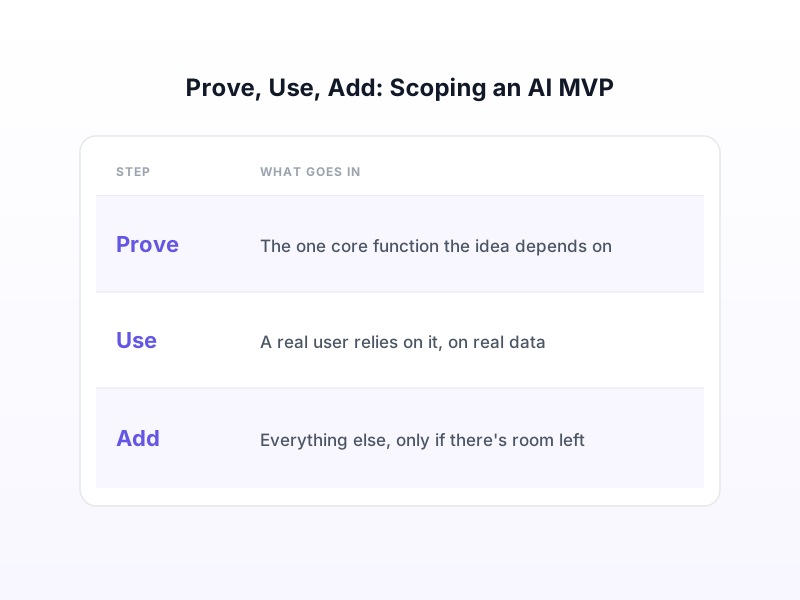
The rule I scope every MVP with has three steps, in order. I call it Prove, Use, Add.
- Prove — find the one core function the idea depends on. Not the product, the single piece that has to work for any of it to matter. For an RFQ tool it's turning a messy request into matched, priced options. For a design tool it's turning inspiration into real products. If this piece fails, nothing else is worth building.
- Use — a real user has to rely on it, on real data. Not a demo you narrate. Someone does their actual job with it. This is where the MVP earns its name, because it's the first time you get evidence instead of opinions.
- Add — everything else goes in only if there's room. If budget and time remain after the first two, the next most useful thing goes in. If not, it waits for the next phase, where real usage will tell you whether it still matters.
In practice, "Add" is where almost everything gets cut. The interface stays simple. Admin panels and dashboards wait. A person reviews or approves at the end instead of the system automating every step. The first version reads from a spreadsheet or a manual export instead of being wired into your CRM or ERP. None of that is cutting corners. It's refusing to pay for answers to questions you haven't asked yet.
What never gets cut is the core function itself, and the proof that it works on your real data. That's the whole point of the money.
Why Version One Is Weak on Purpose
A tight MVP isn't a finished product, and I say so before we start. On the RFQ automation build, version one's accuracy, speed and coverage were all low, by plan. The first goal was just getting the most basic task working end to end. Accuracy passed 90% after the second iteration, not the first.
That's how AI systems actually get built: grown on real data, not specified upfront. It's also why scope creep costs more in AI than in ordinary software. Every feature you add before real use is one more thing you'll probably rebuild once real use shows you what it should have been.
So the real cost of getting an AI product right isn't one big number. It's a small first number, then phases you choose to pay for once you've seen what the first one taught you.
How to Estimate Your Own AI MVP This Week
You can get to a realistic number without hiring anyone:
- Write the one core function in a single sentence. If you need "and" twice, you have more than one MVP.
- Name the real user and the real data. Who uses it first, and on what? If you can't name either, test the idea before you build it.
- List every other feature you want, then move all of it to "Add". Put back only what the core function literally can't work without.
- Decide in advance what "ready to test" means. Write it down before the build starts, so you can't quietly move it later.
- Size what's left. The MVP scope estimator gives a rough timeline and budget in a few minutes.
If you're weighing who should build it, what a fractional AI team actually does covers how that works, and turning a GenAI proof of concept into a real product covers what changes once the MVP has to hold up in production.
If you have an idea and want to know which step it's really at, and what a realistic budget looks like for your version, Get Expert Input.
Related reading
- How to Build an AI MVP Without Wasting Months on the Wrong Features
- How AI Systems Actually Get Built: Why Version 1 Is Never the Final Product
- Why Does My AI Demo Break With Real Data?
- MVP Estimation: Know Your Timeline and Budget Before You Start
This post is part of the Building with AI Guide.
Get the next one in your inbox
One practical AI idea per week, from real client projects. No fluff, unsubscribe anytime.