Why Does My AI Demo Break With Real Data? Prototype vs. Product Architecture
By Amin Rabinia · Founder, Glissando AI
Founders usually arrive a little embarrassed. They built something, with a no-code tool, with an AI coding assistant, with a weekend and a lot of prompting, and it worked. They showed it to a partner, or an investor, or just to themselves at 1am. Then they pointed it at real data, real users and real edge cases, and it fell apart.
Here is the reframe I give them, and I mean it literally: the demo didn't fail. It succeeded, and then it was finished.
A demo has one job: show that the idea works. Most founders who come to me weren't expecting a product out of it, and they were right not to. The mistake comes next, in what they assume the remaining gap is. They assume a product is the demo plus more work: more features, more polish, more error handling, more of what is already there. It isn't. Going from a working idea to a working product is a different kind of work, and almost none of it starts in the code.
It's design and architecture. That is the whole answer, and the rest of this post is what that means in practice.
Why real data is the thing that exposes it
Real data doesn't break a demo because data is hostile. It breaks a demo because a demo is built around a chosen example. Somebody picked an input that shows the idea well: a clean document, a typical customer, a request phrased the way you would phrase it. Everything downstream was built to handle that one shape, because handling that one shape was the entire point.
Real data has no single shape. It arrives in formats nobody planned for, with fields missing and context the system has never seen. And the demo has nothing to sort it into: no vocabulary for what things are, no place to put them, no definition of what a correct answer even looks like. The code isn't especially fragile. There is simply nothing underneath it.
There are genuine technical failure points too: latency the architecture can't absorb, secrets that were fine in a prototype, one giant prompt doing five jobs at once. I've written about the four things that reliably break when a GenAI proof of concept meets production. But every one of those sits downstream of the question this post is about: what is this thing, and what is it actually for?
What solution architecture actually means
Before I design anything, I want to understand the context the product will live in. Where will it really be used? What market is this? Who is the user, the person with the thing open in front of them? Who is the customer, the person who decides to pay, who is frequently not the same person? And the one that matters most: what is the main function of this product?
Not the feature list. The function. I've made this argument at length in why function beats features, and it is the question demos are worst at answering, because a demo is by its nature a demonstration of features. Ask a founder what their product does and you will usually get a list. Ask what the one thing is that, if it stopped working, would make the whole product pointless, and that is the function. Everything else is negotiable.
Working that out is the part founders don't know to ask for, and it's most of what an AI strategy engagement actually produces before a line of production code exists. Only after it do I design the architecture, and the order of that design matters more than any individual decision inside it.
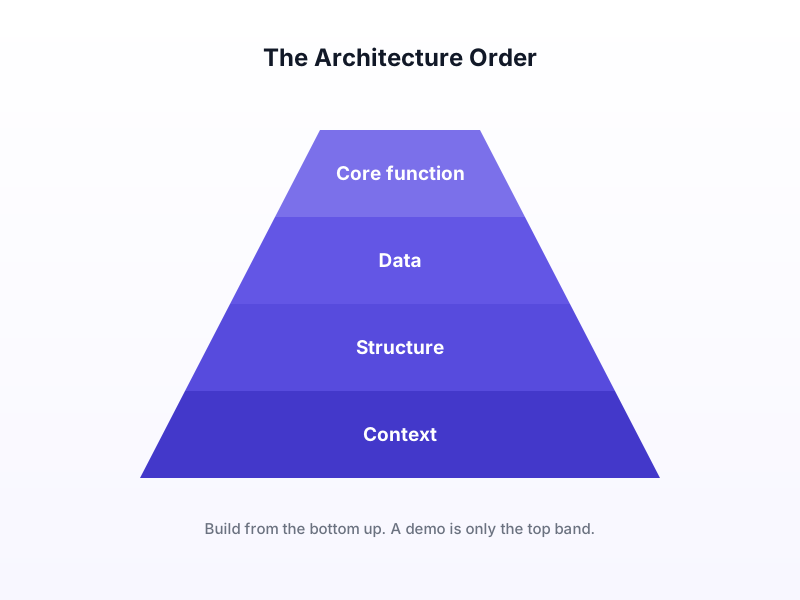
The Architecture Order
Four layers, built from the bottom up. Each one constrains the one above it, which is exactly why doing them out of order produces something that has to be thrown away.
1. Context. Market, user, customer, main function. The output isn't a document. It's one sentence you can say out loud about what this does and who it's for. If you can't say it, nothing below this line can be designed, only guessed at.
2. Structure. Does this domain need a taxonomy, an ontology, a knowledge base? Some do, some genuinely don't. Where the domain runs on tacit, subjective judgement, structure is the thing that turns AI output from vibes into something consistent. On the IQ Design build, we put real time into researching and refining a design taxonomy, a structured vocabulary connecting what the AI saw in an inspiration photo to actual products in inventory. It saved months of patchwork. Another team working a similar problem tried to do it with prompt engineering and no research; their outputs came out inconsistent and unsystematic. That is the unglamorous work that decides whether an AI product is any good, and you can see it in the IQ Design case study.
3. Data. The pipeline and the database that serve that structure. Where data comes from, what shape it gets normalised into, where it lives, how it gets updated. Unglamorous, and most of your reliability lives here.
4. Core function. Now build the main function for the main user. Only that. Then follow best practices and build it properly, because at this point you are building one known thing rather than exploring.
Lean is not a smaller version of big
The instruction I give myself on every build is: keep it lean, keep it small, keep it simple and elegant. Don't overengineer. Make sure it works for the main use case, for the main function, for the main user. Strip out the distractions and the noise.
Founders sometimes hear that as "build less because we can't afford more", a compromise made for budget reasons. It isn't. Focus is the thing that makes a system scale. A lean, focused product scales because there is less of it to break, one direction for it to grow in, and every piece of it is load-bearing for the same purpose. Ten half-working features scale in no direction at all, because there is no direction: each one pulls the architecture somewhere different.
One thing right beats ten things half-broken. That isn't a motivational line, it's an architectural one.
The failure that isn't technical at all
Most of the products I've watched fail didn't fail because the technology was fragile. They failed from lack of focus.
A product trying to handle many different things, with no main direction, breaks under tension: a new requirement arrives and there is no principle saying where it belongs, so it ends up everywhere. And even when the system holds together, the business version of that failure is worse. No direction means no growth path and no clear value delivered back to the business, and eventually somebody looks at it honestly and kills the program.
That is the uncomfortable version of "my demo breaks on real data". Sometimes real data isn't exposing a bug. It's exposing that nobody has decided what the product is, and the data is just the first thing honest enough to say so. When that's the case, the fix is rarely in the build. It's usually about which side of the founder, market, and product triangle has been left weak.
What to do with the demo you already have
- Keep it, don't harden it. The demo is evidence the idea works. That's valuable, and it's done. Hardening a demo means paying to make the wrong architecture more durable.
- Answer the context questions in writing. Market, user, customer, main function: in one sentence, said out loud, to somebody who will push back on it.
- Decide the one function, and write down what you are deliberately not building yet. The list of what's cut is more useful than the list of what's in.
- Then build lean, from the bottom up. Expect version one to be narrow and unimpressive. That is what version one is for. On the RFQ automation build, v1's accuracy, speed and coverage were all low, and that was communicated up front before anyone wrote code.
Rebuilding a demo is cheap. Rebuilding a product you spent six months and most of your runway on because nobody ever decided what it was is the expensive one, and it's the one I get called about most.
If you're sitting on a demo that works and you're not sure what the next version should even be, that is the conversation worth having before the build starts rather than after it. It's most of what Get Expert Input calls turn out to be about.
This post is part of the Building with AI Guide, everything we've written on turning an idea into a working product.
Related reading
- How Do You Productionalize a GenAI Proof of Concept? The 4 Things That Break First
- Building AI Products That Work: Why Function Beats Features Every Time
- What Actually Makes AI Products Work? It's Not the Model You Choose
- How to Build an AI MVP Without Wasting Months on the Wrong Features
- How AI Systems Actually Get Built: Why Version 1 Is Never the Final Product
Get the next one in your inbox
One practical AI idea per week, from real client projects. No fluff, unsubscribe anytime.