Why Do Startups Struggle? The Startup Triangle
By Amin Rabinia · Founder, Glissando AI
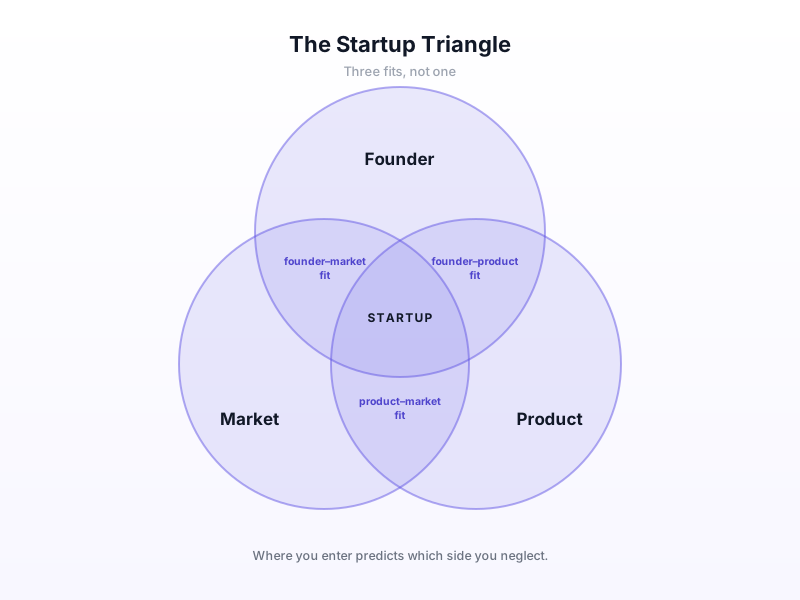
Tell me where a founder came from, and I can usually tell you how their startup is going to get stuck. Not whether it fails: how it fails. The shape of the problem is predictable.
Every startup is three things: a founder, a market, and a product. That means three fits, not one.
- Product-market fit: does what you built match what the market actually wants?
- Founder-market fit: do you genuinely understand the market you picked?
- Founder-product fit: can you get it built, and tell whether it's being built well?
Almost everyone measures the first. The other two decide whether you ever get there. And where you enter the triangle predicts which side you'll neglect.
Prefer to watch? Here is the same argument in four minutes:
Coming from the market
You know the industry cold, who buys, why, what they complain about. You've never built a product. The gap doesn't show up as "I can't code." It shows up as: you can't tell whether the person you hired is any good. You can't tell whether the build is on track or quietly failing. Your vision doesn't survive the trip into the actual product. You either trust too much or micromanage, because you have no instrument for judging the work. If that's you, the highest-leverage thing you can learn isn't how to build. It's how to evaluate the person who will.
Coming from the product
You've built things before, so you keep building. Polishing, refactoring, adding one more feature, because that's the part you're good at and the part that feels like progress. Months pass without a real user touching it. Then you launch, and everything the market would have told you a year ago arrives at once, late and expensive. The discipline that fixes this is deliberately putting a weak version in front of real people: version one is supposed to be weak.
Coming from neither
Sometimes the weak side isn't a side. It's the founder. Running on enthusiasm and an idea that's still vague. The tells are traits, not skills: no appetite for risk, or so much excitement that judgment goes. Too rigid and structured to survive the plan changing. Enough ego that outside input never really lands. No way of working with the people who'd cover the gaps. Being a founder is its own skill set, and it's the one nobody checks, because everyone assumes it's a given.
Nobody is only one of these
This isn't a personality test. Market people often have real product instincts. Technical founders often know their users better than they get credit for. It's a mix, and the mix shifts as you learn.
The point isn't to label yourself. It's to find your weakest side and be honest that it's the weakest, because the failure attached to it is already on its way.
Most founders only ask the third, and only once it's too late to act on the answer cheaply. The two they skipped are the reason the third one hurts.
If your weakest side is the product one, that's the side worth buying help for rather than teaching yourself on a live company. That's most of what Get Expert Input conversations turn out to be about.
This post is part of the Building with AI Guide, everything we've written on turning an idea into a working product.
Related reading
Get the next one in your inbox
One practical AI idea per week, from real client projects. No fluff, unsubscribe anytime.