RFQ Automation

RFQ Automation:
An AI Engine That Quotes in Seconds

Every incoming RFQ costs your team 15–45 minutes of manual research — reading specs, cross-referencing vendor catalogs, pulling pricing history, building the comparison. We build custom RFQ engines that do that research automatically and hand your buyer a ranked recommendation to approve.

The Problem

Quote Volume Grows. Headcount Doesn't.

RFQ processing is the bottleneck nobody budgets for. Volume climbs, response times slip, and buyers start losing deals to whoever quoted first — not whoever quoted best.

Manual RFQ Processing

Every quote costs 15–45 minutes of analyst time

Reading unstructured specs out of emails and PDFs
Cross-referencing vendor catalogs by hand
Digging through past quotes for pricing context
Rebuilding the same comparison sheet every time
Response times slipping as volume grows
With an RFQ Engine

The research is done before anyone opens the request

Requirements extracted automatically from raw text
Suppliers scored against the actual spec
Pricing history and benchmarks pulled in context
A ranked comparison waiting for approval
Same team handles 3× the volume
The Method

The RFQ Engine: Parse → Match → Price → Rank

Four stages, each doing one job. A human approves at the end — the engine never awards a contract on its own.

1

Parse

Pull structured requirements — product type, quantity, specs, tolerances, deadline — out of unstructured RFQ text, wherever it arrives: email body, PDF attachment, web form, spreadsheet.

2

Match

Score and rank suppliers against the parsed requirement using your catalog and historical performance data — fill rate, lead time, quality history — not just who's alphabetically first.

3

Price

Pull quote history and market benchmarks so the numbers arrive with context: what this part cost last quarter, what this vendor usually quotes, whether the bid is in range.

4

Rank

Produce a ranked vendor comparison with the reasoning attached, ready for a buyer to review and award in minutes instead of assembling it from scratch.

The staging matters more than the model choice. Each stage fails differently and gets measured differently — which is what makes the engine debuggable when a quote comes out wrong. Read the reasoning in how many AI agents your product actually needs →

Proof

30 Minutes to Under 60 Seconds, in Production

A B2B procurement team was handling dozens of RFQs a day entirely by hand. Volume was growing, headcount wasn't, and response times were costing deals.
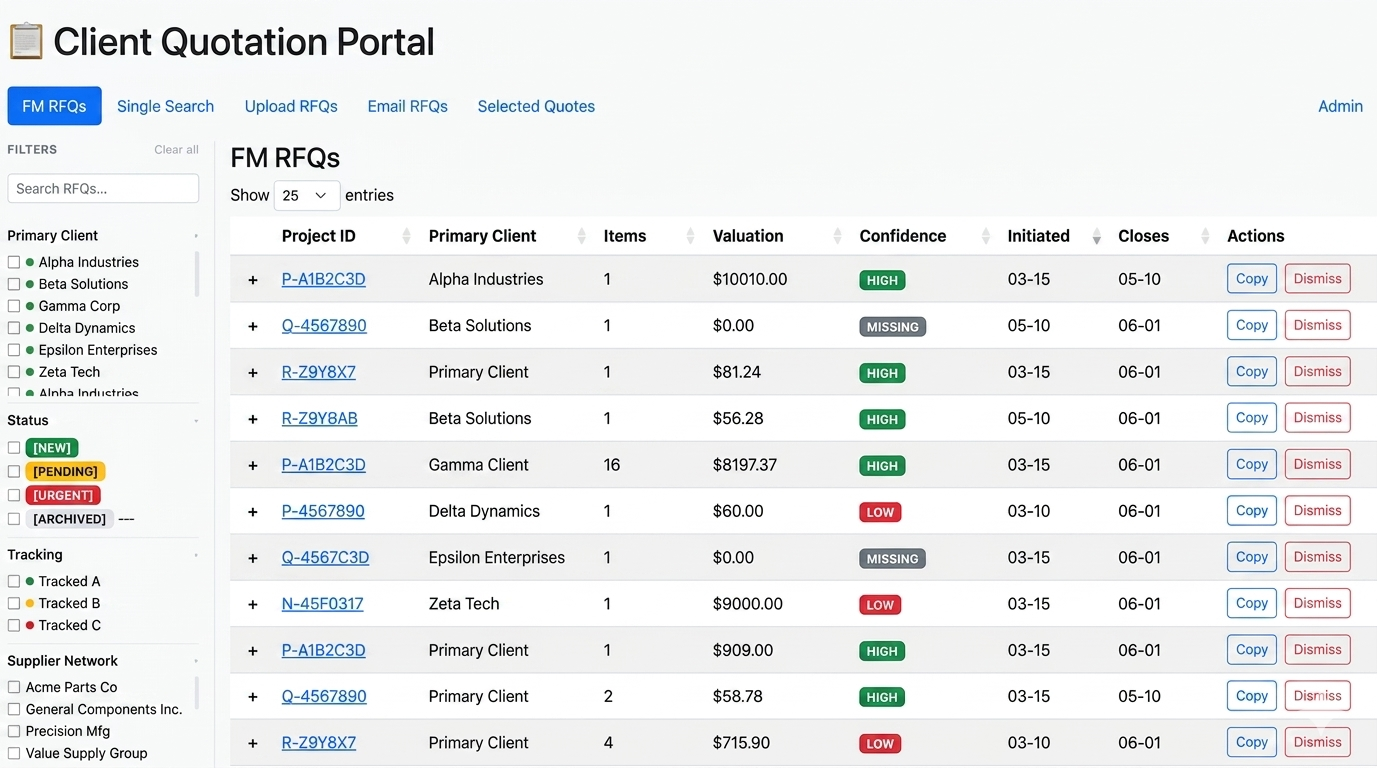
RFQ automation management dashboard showing quote comparisons and vendor performance
Research time: 30+ minutes → under 60 seconds per RFQ
Team capacity: effectively tripled, no new headcount
Recommendation accuracy: above 90% on production RFQs
Compliance: full audit trail on every decision

"We needed help with full automation and data analytics. Glissando AI has created an AI search tool that does most of the research needed for proposals. Glissando AI's work has improved our time savings, efficiency, and accuracy."

Read the Full Case Study →
Where It Fits

Quote-Heavy Businesses, Not Just Procurement Departments

Manufacturing Procurement

Machine parts, tooling, and materials RFQs where specs arrive in inconsistent formats and matching depends on real tolerances, not keyword overlap.

B2B Distribution

Distributors fielding high daily quote volume across a large SKU catalog, where speed of response decides who wins the order.

Multi-Entity Operations

Groups running several business units or regions, where each entity has its own vendor list, pricing agreements, and approval rules on one shared pipeline.

Email & PDF Intake

Where RFQs arrive as free-text emails with spreadsheet or PDF attachments and someone currently retypes them into a system by hand.

Quote-to-Award Cycles

Any process where the gap between request received and vendor awarded is measured in days and could be measured in hours.

Inbound Quote Conversion

Manufacturer and supplier websites where inbound quote requests sit in an inbox until someone has time to research them.

How We Work

Data Pipeline First, AI Second

We build the intake, storage, and processing layer before any AI ranking goes in — so you stop losing quote and vendor data while the system is still being built, and so the model has real history to learn from when it arrives. Activation comes after the data is clean and flowing, not before.

You own everything at the end: code, data, and infrastructure, from day one. No licensing-back, no retained rights.

Get Expert Input ($99) → AI Automation Consulting →
Common Questions

RFQ Automation FAQ

What is an RFQ engine?
An RFQ engine takes an incoming request for quote, extracts its requirements automatically, matches it against your supplier base, pulls relevant pricing history, and returns a ranked vendor recommendation — replacing the manual research a buyer would otherwise do by hand. The buyer still makes the award decision; the engine removes the hours of prep work in front of it.
How much time does RFQ automation actually save?
On the production build documented in our case study, RFQ research went from 30-plus minutes per request to under 60 seconds, and the team's effective capacity tripled without adding headcount. Your numbers depend on how much of your current time goes to research versus negotiation — the research part is what gets automated.
Does it replace the buyer?
No, and it shouldn't. The engine does the mechanical work — parsing, matching, pricing, ranking — and a human makes the award. What changes is that your buyer reviews a ranked comparison instead of spending half an hour assembling one. Judgment stays with the person; the busywork doesn't.
Can it handle non-standard specs and custom units?
Yes, but not perfectly on day one. Early versions handle the common cases well; accuracy on edge cases like non-standard spec formats and custom unit conventions improves once the parsing is retrained on your real RFQ patterns. We set that expectation up front rather than promising a finished system in week one.
Can it work across multiple entities or business units?
Yes. Vendor catalogs, pricing agreements, and approval rules stay scoped per entity while sharing one parsing and ranking pipeline — so a group with several regions or business units gets consistent processing without merging data that should stay separate.
How does it integrate with our existing ERP or procurement system?
The engine sits in front of your system of record rather than replacing it. It intercepts the RFQ, does the research, and writes the structured result back — so buyers keep working where they already work. Integration shape depends on what you run; that's part of the scoping conversation.
What does an RFQ automation build cost?
Automation projects start at $10K and scale with integration complexity, data readiness, and how many entities or catalogs are in scope. A paid scoping session gets you a concrete range for your situation before you commit to anything.
Who owns the code and data?
You do, entirely, from day one — code, data, and infrastructure, with no licensing-back or retained rights on our side.

How Many Hours a Week Go Into Quoting?

30 minutes with a senior AI consultant. Bring your actual RFQ volume and intake format — you'll leave knowing what's automatable, what it would take, and whether it's worth building.

Got Questions?

Send Us a Message

We'll reply within one business day.

+1 916 936 1544
Sacramento, CA
Waking up the assistant…