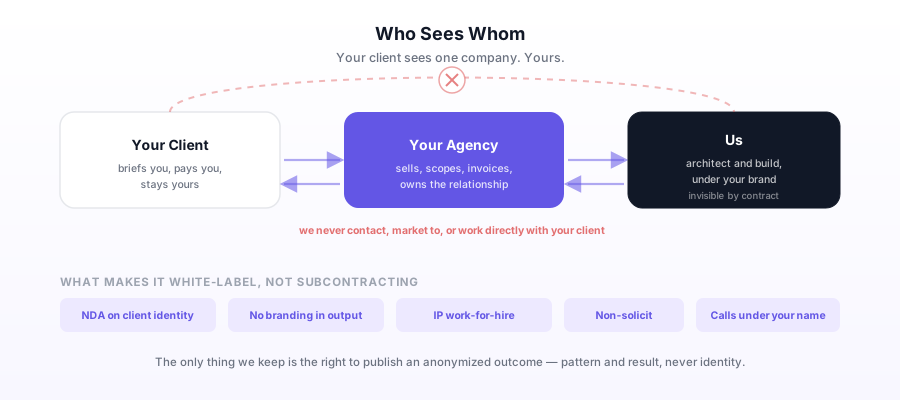
Will you contact or poach our client?
No — and it's contractual rather than a promise. We sign an NDA covering client identity, agree a non-solicit prohibiting us from contacting, marketing to, or working directly with your client, and our branding never appears in any deliverable. If we join a client call at all, it's only at your invitation and under your agency's name and email.
Who owns the code we pay you to build?
You do. IP is assigned to the agency as work-for-hire on completion, along with the code, data, and infrastructure. No licensing-back, no retained rights on our side. If you later want to bring maintenance in-house or move to another partner, nothing is locked to us.
What does a project cost, and how do we price it to the client?
Projects start at $15,000 and scale with integration complexity and data readiness. You mark up at whatever your market supports — we don't set or police your client pricing, and we don't need to see it. For recurring demand, a monthly retainer for senior build capacity is more predictable than quoting each project separately.
How is this different from a white-label chatbot platform?
Platforms are genuinely the right answer for commodity requests — a standard site chatbot, a templated assistant. If that's what your client needs, use one and keep the margin. We're the call you make when the platform can't do it: custom multi-agent systems, automation touching real business data, forecasting, and systems that must run unattended in production.
How is this different from hiring an offshore development shop?
Staffing shops supply capacity against a specification you have to write. If you're not technical, writing that specification is the actual hard part — and a wrong one gets built faithfully and expensively. We do the architecture and judgment: deciding what to build, what to cut, and where the system will break before it's live.
Do you publish anything about work you do for our clients?
Only anonymized outcomes — the pattern and the result, never your client's identity or yours. For example: "a 40-person SEO agency's client, quote turnaround reduced from X to Y." It's a stated term in the agreement rather than something negotiated afterwards, so there are no surprises.
What if our client's project fails or stalls?
We tell you early rather than late. Version one of an AI system is normally weaker than the demo that sold it, and we say so up front so you can set the client's expectations rather than absorb the gap yourself. If something isn't going to work, you hear it from us at the scoping call, not three invoices in.
Can you work with our timezone?
We work with agencies in the US, UK, and Australia. Delivery is async-first with scheduled overlap for scoping and review calls, so the timezone gap doesn't become the bottleneck on turnaround.