How to Validate a Business Idea Before Building: The Core, Form, Market Framework
By Amin Rabinia · Founder, Glissando AI
"Should I build an app or a website?" is one of the questions I hear most from founders. It is almost never the real question.
A client came to me recently with a version of it. Their service already had a website, the website wasn't getting traction, and they wanted a prototype app to gauge interest without paying for a full app. That's a sensible instinct, and I hear the same thing from several other clients in different words. It has the same blind spot every time.
A website and an app are both forms. When one form isn't working, swapping in another is the most tactical move on the table. Sometimes it's the right move. More often the problem lives somewhere a new form can't reach.
That's why I think most advice on how to validate a business idea starts in the wrong place. It jumps to testing a landing page, an ad or a prototype, which are all forms, before checking whether the idea at the center is sharp enough to test. Validation has an order, and it runs from the inside out.
The Core, Form, Market framework
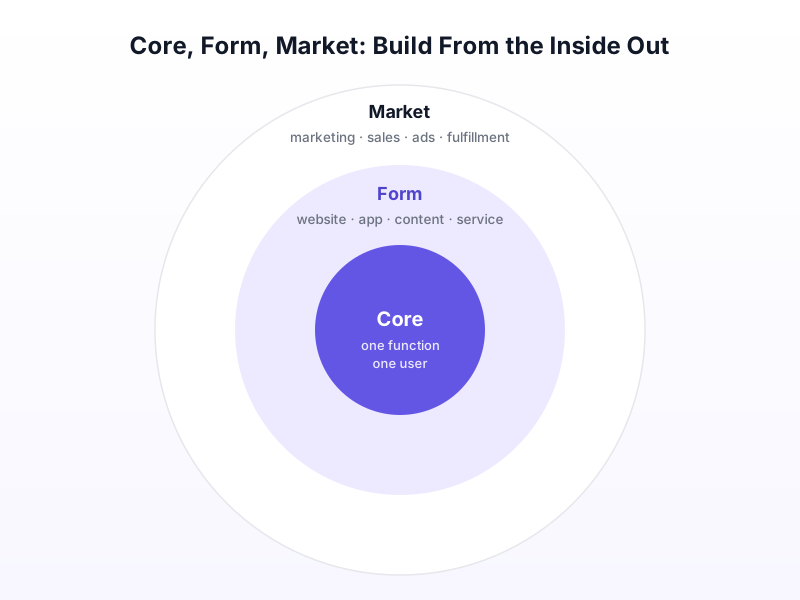
Every product is three rings, and it gets built from the inside out:
- Core: the idea itself. One main function, for one main user. Not a feature list: the one thing your product does, and the one person it does it for.
- Form: the shape the product takes to deliver the core. A website, an app, content, a service, an AI agent working behind an email inbox. The same core can live in many forms.
- Market: everything around it that reaches people. Marketing campaigns, go-to-market, sales, advertising, fulfillment.
The order matters. The form exists to deliver the core. The market exists to bring people to the form. If the core is fuzzy, every ring outside it inherits the fuzz: the website says three things at once, the app has twelve screens, and the ads can't decide who they're talking to.
Why founders start at the form
Founders want to introduce their idea and their product to the world. So they go straight to the form: a website, an app, a list of features. I understand why. The form is the visible part. You can show someone a website. You can't show them a core.
But the questions that get skipped are the ones that decide everything else. What is the core product I'm creating? What is its main function? Who is its main user? Most founders I talk to are too tactical to step back and see that picture, so they keep rebuilding the outer rings around a center they've never pinned down. (This is the same trap I wrote about in why function beats features: the list of features grows because nobody decided what the one function was.)
Find the ring your problem is in
"The website isn't getting traction" can be a problem in any of the three rings. Each one looks different once you know what to look for.
It's a market problem when the people who do find you get it, and some of them buy, but not enough people find you. That's reach. A new form won't fix it: an app nobody knows about has exactly the same problem as a website nobody visits. The work here is marketing, sales and distribution, including whether you even show up when someone asks ChatGPT about the problem you solve.
It's a form problem when the right people show up, understand what you do, want it, and the shape still gets in the way. The function needs to happen on a phone, in the field, every day. Or it needs to remember the user, or nudge them at the right moment, and a page of text can't do that. This is the case where a different form really is the answer.
It's a core problem when visitors arrive and can't tell what it is or who it's for. You describe it differently every time someone asks. You have three target users and a feature for each. No form and no campaign fixes this, because there's nothing sharp for either of them to carry.
Here's why this matters before you spend money. A prototype app tests the form ring. If the real problem is in the core or the market ring, the prototype gets no traction either, and you've paid to learn something a few honest answers could have told you.
Answer them in that order. If the first answer is shaky, stop there. Everything outside the core gets easier once it's fixed, and nothing outside it works until it is.
When the app really is the answer
None of this means a prototype is a bad idea. If the core is sharp and you can point to evidence that the form is in the way, a prototype is one of the cheapest, clearest tests you can run. And it doesn't need to be a full app. It needs to deliver the core function to the core user, well enough that their reaction tells you something.
That's the thinking behind the free working demo I build: a real, working sample around your core, in about a week, so you can test a form before you commit a budget to it. Be clear on what a demo proves and what it doesn't, though; a demo that works is not yet a product. If the test holds up, the next step is an MVP, which for most of the products I build lands at $2k–$10k and 4–8 weeks as long as the scope stays on the core.
And sometimes the right form isn't an app or a website at all. For a lot of service businesses, the core function is a job that gets done for the customer: a quote prepared, a document reviewed, a request handled. That can be an AI agent working quietly behind a simple form or an email address, with nothing new for the customer to download.
Focus pays twice
Keeping everything aimed at the core does two jobs at once. It makes the build more strategic, because every screen and feature has to earn its place by serving the one function. And it makes the marketing more focused, because you finally know who you're talking to and what you're promising them.
That solves far more problems than being tactical, unfocused and all over the map. A founder with a sharp core and a plain website will usually do better than a founder with a fuzzy core and a beautiful app.
If you can't tell which ring you're stuck in, that's a good use of an outside opinion. It's most of what I do in strategy work and in Get Expert Input sessions: find the ring first, then decide what's worth building. If you suspect the weak spot is you rather than the product, the Startup Triangle is the companion to this one.
This post is part of the Building with AI Guide, everything we've written on turning an idea into a working product.
Related reading
Get the next one in your inbox
One practical AI idea per week, from real client projects. No fluff, unsubscribe anytime.