Can a Voice AI Agent Actually Answer Your Business Phone Calls? What We Learned Building One
By Amin Rabinia · Founder, Glissando AI
For most small businesses, the phone is still the single biggest revenue channel nobody's watching closely enough. Every missed call is a customer who either tries again later or, more often, calls the next business on the list. Voice AI agents promise to close that gap: answer every call, book the appointment, take the order. But the honest question is whether that promise actually holds up yet, or whether it's still mostly demo-hype.
We've built one. Not a demo, but a working voice agent handling live phone orders. That gives us a real answer, and it's more nuanced than "yes" or "no."
Why the Phone Is Still the Hard Problem
Chat widgets, email, and forms are asynchronous. A slow response is mildly annoying but not disqualifying. A phone call is not. If a caller says something and waits three seconds for a reply, that silence reads as "did this call drop," not "the system is thinking." Voice is the least forgiving channel in customer-facing AI, which is exactly why it took longer to get right than chatbots did.
It's also the channel small businesses are most exposed on. A missed call to a restaurant, a home services company, or a local shop doesn't get a second chance in the same way an unread email might. The caller is often solving an immediate need and will simply call whoever picks up. That's the actual business case for a voice agent: not novelty, but capturing revenue that's currently walking out the door because no one answered.
What Our First Voice Agent Build Actually Felt Like
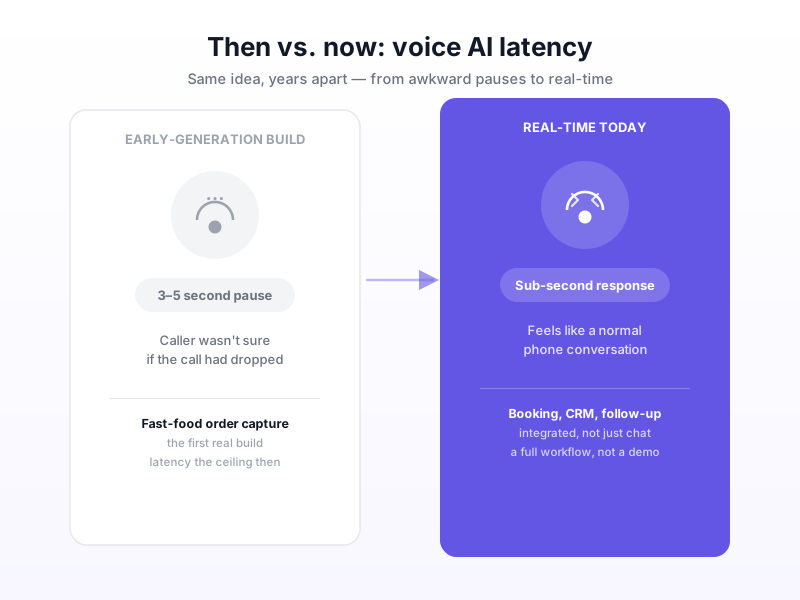
Our first real voice agent build was for capturing phone orders, the kind of call a quick-service restaurant gets dozens of times a shift. It worked, in the sense that it could hear an order, understand it, and record it correctly. What it couldn't do well was respond fast enough to feel like a phone call instead of a system processing a request.
The pauses between what a caller said and what the agent said back ran three to five seconds, long enough that callers would ask "hello, are you there?" mid-order. That's not a small UX issue. On a phone call, that pause is the entire experience. Everything else about the system could be working correctly and it would still feel broken, because a phone conversation has an expected rhythm and that build didn't hit it.
This wasn't a mistake in how the system was built; it was close to the actual limit of what was possible with the speech and language models available at the time. That's worth saying plainly: version one is rarely the final product, and with voice specifically, some of what feels like a flaw in year one is a genuine technology ceiling that moves as the underlying models improve, not something better engineering alone would have fixed.
What Changed: Real-Time Is Now Actually Real-Time
The gap between that early build and what's available today isn't incremental; it's the difference between a system you have to work around and one that feels close to a normal conversation. Response latency has dropped from multi-second pauses to something close to sub-second, which is the threshold where a voice agent stops feeling like a system and starts feeling like a call.
That shift matters more than any individual feature improvement, because latency was always the thing standing between "technically works" and "customers will actually use this without getting frustrated." A voice agent that understands orders perfectly but responds too slowly loses to a human every time, because callers hang up or ask for a person. Solve the latency and the same underlying capability becomes genuinely usable.
The other real shift is integration. An early voice agent that just captures information into a transcript is a novelty. One that books directly into a calendar, updates a CRM record, and triggers a follow-up is doing the actual job, following the same pattern we've written about in how a real AI agent completes a full workflow, not just one step of it. For voice specifically, that means the call doesn't just get answered; it results in an appointment on the calendar or an order in the system, with no one re-typing anything afterward.
What's Realistic in 2026, Honestly
Voice agents are genuinely good at structured, repeatable calls: taking an order from a known menu, booking an appointment against a real calendar, answering the same five questions your front desk answers fifty times a day, capturing a lead's contact details and reason for calling. These are calls with a predictable shape, and that predictability is exactly what makes them automatable well.
They're not yet the right fit for calls that require real judgment, emotional nuance, or negotiation: a frustrated customer with a complex complaint, a situation that needs someone empowered to make an exception, or a call where the caller doesn't know what they need and has to think out loud with a person. Routing those to a human, fast and without friction, is part of a well-designed voice agent, not a failure of it.
The honest evaluation question isn't "can AI answer my phones." It's "what fraction of my calls are structured enough to automate well, and does that fraction justify the build." For a business fielding the same handful of call types dozens of times a day, that fraction is usually high. For a business where every call is genuinely different, it's lower, and that's worth knowing before committing to a build, not after.
What This Means for You
If missed calls are costing you business, the technology to fix that has crossed a real threshold. This isn't the same voice AI that felt clunky and robotic a few years ago. But the value depends entirely on matching the agent to the calls that are actually structured enough to automate, and building the integration so a captured call becomes a booked appointment or a placed order, not just a transcript someone still has to act on.
If you're getting a high volume of repetitive calls, such as orders, bookings, or the same handful of questions, that's usually where a voice agent pays for itself fastest. If you're not sure whether your call volume fits that pattern, that's a scoping conversation worth having before any build starts. Get Expert Input, a paid session where we look at your actual call patterns and tell you honestly whether a voice agent is the right move right now.
This post is part of the AI Agents Guide, from the basics to the technical depth behind agents that actually work.
Related reading
Get the next one in your inbox
One practical AI idea per week, from real client projects. No fluff, unsubscribe anytime.