What Is an RFQ Engine? The Four Stages of Automated Quote Processing
By Amin Rabinia · Founder, Glissando AI
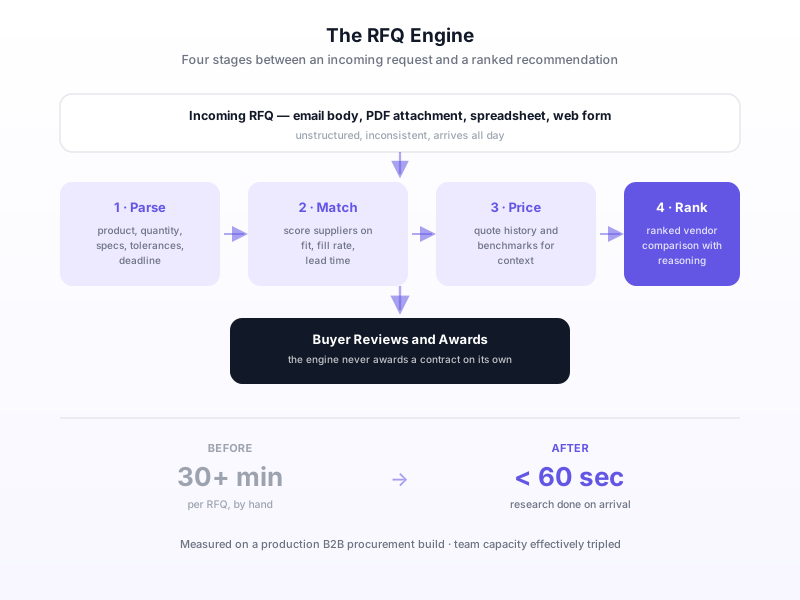
An RFQ engine is the system that sits between a quote request arriving and a buyer deciding. It reads the request, works out what's actually being asked for, finds the suppliers who can fill it, puts prices in context, and hands over a ranked comparison — automatically, before anyone opens the email.
That's the definition. The more useful question is what it's made of, because "we'll automate RFQs with AI" is the kind of statement that sounds like a plan and isn't one. An engine that works has four distinct stages, and each fails in its own way.
Why Quote Processing Eats So Much Time
A single RFQ takes 15 to 45 minutes of analyst time when it's done by hand, and almost none of that is decision-making. It's reading requirements out of a paragraph someone typed in a hurry, opening vendor catalogs, remembering which supplier fell through last quarter, digging up what this part cost the last three times, and rebuilding the same comparison sheet from scratch.
That work is mechanical, and it scales linearly with volume. Which is why quote processing becomes a bottleneck at exactly the wrong moment: business is growing, requests are climbing, and the only lever anyone can find is hiring. Meanwhile response times slip, and in most B2B categories the buyer who quotes first has a real advantage over the one who quotes best.
Stage 1: Parse
The first job is turning an unstructured request into structured fields — product type, quantity, specifications, tolerances, delivery deadline — regardless of whether it arrived as an email body, a PDF attachment, a spreadsheet, or a web form.
This is where most RFQ automation projects underestimate the work. Requests do not arrive in a consistent format, and the interesting failures are all in the long tail: non-standard spec formats, custom unit conventions, a quantity written three different ways, a critical tolerance mentioned in a sentence rather than a field.
Expect the first version to handle common cases well and to get noticeably better on edge cases once it's been retrained on your real request patterns. That's not a defect, it's how these systems mature — the same pattern as any AI system that improves on production data rather than being specified upfront.
Stage 2: Match
With structured requirements in hand, the engine scores suppliers against the actual requirement. The important word is scores — not filters. A keyword filter returns everyone who stocks the category. A scoring model ranks them on how well they fit this specific request: capability against the real spec, historical fill rate, lead time, quality history.
This stage is where institutional knowledge that normally lives in one experienced buyer's head becomes something the system applies consistently. The analyst who knows a particular vendor is reliable on tight tolerances but slow on volume is encoding judgment that a new hire wouldn't have. Matching against performance history is how that knowledge survives someone leaving.
Stage 3: Price
A number with no context is not useful. Stage three pulls quote history and market benchmarks so the buyer sees not just what a vendor is asking, but whether that's in line with what this part cost last quarter and what this vendor usually quotes.
This is the stage that most directly protects margin, and it's the one most often skipped in a first build because it requires historical data to be clean and accessible. Which is exactly why we build the data pipeline before the AI ranking on these projects: get intake, storage, and processing running first so you stop losing quote history while the system is being built, then layer activation on top once the data is stable. Get that order backwards and stage three has nothing to work with.
Stage 4: Rank
The final stage produces a ranked vendor comparison with the reasoning attached — not just an ordering, but why this supplier came out on top for this request.
The reasoning matters more than the ranking. A buyer who can see why the engine put a vendor first can disagree with it intelligently. A buyer handed an unexplained ordering either trusts it blindly or ignores it entirely, and both of those outcomes are worse than the manual process they replaced.
The engine does not award the contract. It removes the half hour of preparation in front of the decision and leaves the decision itself with the person accountable for it.
Why Four Stages and Not One Prompt
You could ask a single large model to read an RFQ and return a vendor recommendation. It would work in a demo and become undebuggable in production, because when a recommendation comes out wrong there is no way to tell whether it misread the spec, scored the wrong suppliers, or mispriced the comparison.
Four stages means four places to look, four things to measure separately, and four pieces you can improve without disturbing the others. That's the same reasoning behind splitting agent responsibilities by genuine job boundaries: each stage has its own context, its own data source, and its own way of failing, which is exactly the test for when work deserves to be separated.
What It Actually Delivered
On the production build documented in our RFQ automation case study, the outcomes after the second build iteration were: research time down from 30-plus minutes to under 60 seconds per request, team capacity effectively tripled without new headcount, vendor recommendation accuracy above 90% on production RFQs, and a full audit trail on every decision for compliance.
The client's own summary was that the system "does most of the research needed for proposals" — which is the honest framing. It did not replace the buyers. It deleted the research shift that used to sit in front of every quote.
If quoting is eating hours a week at your company, the useful next step is working out how much of that time is mechanical research versus actual judgment — because the first part is what an engine takes over, and the ratio decides whether a build is worth it. That's the conversation to have before anyone writes code. See how we build RFQ engines, or Get Expert Input on your specific quote volume and intake format.
This post is part of the AI Agents Guide — from the basics to the technical depth behind agents that actually work.
Related reading
Get the next one in your inbox
One practical AI idea per week, from real client projects. No fluff, unsubscribe anytime.