How to Build a 24/7 Automated YouTube Content Pipeline Without Losing Quality Control
By Amin Rabinia · Founder, Glissando AI
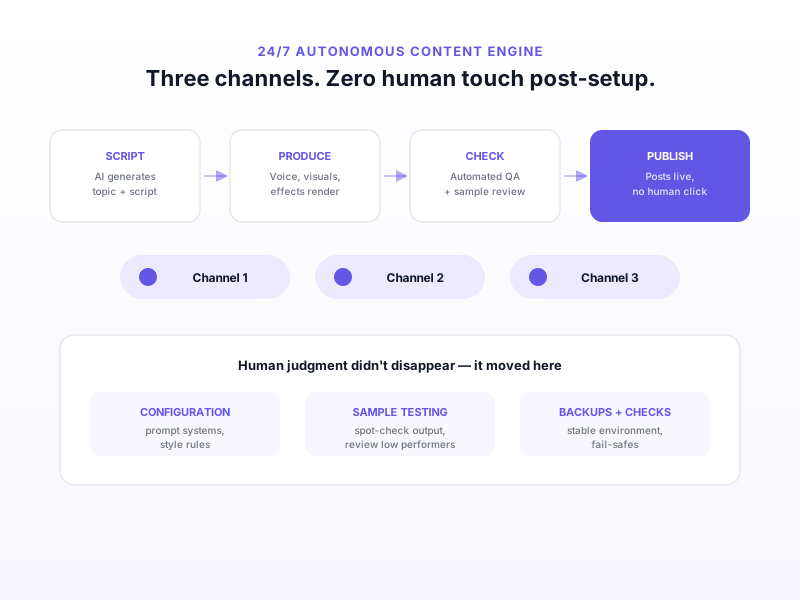
"Fully automated" is the phrase people reach for when describing a content pipeline that runs without anyone touching it day to day. It's also slightly misleading. We run three YouTube channels that post on a schedule with zero human touch after setup — no one is in the loop clicking "publish." One of them, Legends Across America, is publicly viewable if you want to see what the output actually looks like. But calling any of this hands-off undersells what's actually happening.
The human work didn't disappear. It moved. Instead of producing each video, the work became designing the system that produces videos — and that system needed real iteration before it was trustworthy enough to leave alone.
What the Pipeline Actually Does
The system runs four stages on a loop, with no human action required between them: a script stage that generates a topic and a script, a production stage that renders voice, visuals, and effects, an automated check stage, and a publish stage that posts the finished video.
Each of those stages is itself a small AI agent doing one job well, rather than one model trying to do everything. This matters more than it sounds — a single end-to-end model attempting script writing, voice synthesis, and visual generation in one pass produces worse results than dedicated steps that hand off cleanly to each other. It's the same logic behind why different agent architectures suit different jobs — a content pipeline is really a chain of specialized agents, not one generalist.
The result: three channels publishing on schedule, with the only ongoing human involvement being periodic review — not per-video approval.
It Didn't Start Working on Day One
Early output quality was low. Scripts were generic, visuals were inconsistent, and pacing was off. Viewers noticed — early view counts and retention dropped noticeably compared to what we needed for the channels to be worth running.
This is the part that gets skipped in most "we automated X" stories: the system that runs unattended today is not the system that launched. Output improved significantly over time — better scripts, better visuals, better effects — through the same iterative process we use on every AI build. We've written about why version one is never the final product, and this pipeline is a clean example: the V1 config was good enough to prove the pipeline could run end-to-end. It was not good enough to leave alone, and we didn't pretend otherwise.
What changed between V1 and the current version wasn't the core architecture. It was the configuration — better prompt structures, tighter style guidelines, more specific instructions about pacing and tone, learned from watching what the early output actually did wrong.
Where Human Judgment Actually Lives Now
If no one is approving individual videos, the obvious question is: how do you know quality is holding up? The answer is a handful of specific practices, not a vague "we monitor it."
Sample testing. Not every video gets watched, but a consistent sample does — enough to catch drift before it becomes a pattern across dozens of uploads.
Reviewing the low performers. Videos with weak view counts or retention get pulled and reviewed specifically, because they're the ones most likely to reveal a configuration problem worth fixing upstream — for every video, not just that one.
A stable production environment. Render pipelines, voice models, and asset libraries don't get changed casually, because instability at that layer creates inconsistency that's hard to trace back to a cause.
Well-structured prompt systems, backups, and checks. The prompts that drive script and visual generation are treated like code — versioned, tested before wide rollout, with fallback behavior defined for when a generation step fails rather than letting a bad output ship silently.
None of this requires watching every video. All of it requires someone who understands the system well enough to know where it's likely to fail and design a check that catches it early.
The Connection to AI Slop
This is also where the line between "automated content" and AI slop actually gets drawn. The technical capability to generate video at scale is not the differentiator anymore — most teams have access to similar models. What separates a content engine people watch from one they scroll past is whether someone did the configuration work to make outputs consistently good, and whether someone kept checking after launch.
Skipping the review layer doesn't make a pipeline more automated. It just makes the slop arrive faster and in higher volume.
What This Costs You Upfront
Building a pipeline like this isn't a weekend project, and treating it like one is the most common way these efforts fail. The work that has to happen before you can walk away from a channel includes: defining the content format precisely enough that a script generator produces something usable on the first pass most of the time, building the production chain (voice, visuals, editing, effects) as a reliable sequence rather than a one-off demo, and setting up the monitoring practices above before — not after — you stop watching closely.
That sequencing matters. It's the same phased approach we use on every AI build — prove the core works, then earn the right to add more autonomy, rather than starting with full autonomy and hoping it holds.
What This Means for You
If you're considering an automated content pipeline — for YouTube, for a blog, for social — the right question isn't "can AI generate this content?" It almost certainly can. The right question is: what's the configuration and review system that keeps it good after the novelty of automation wears off?
Budget time for that system before launch, not after viewers start dropping off. The pipeline that runs unattended for months is the one where someone did the unglamorous setup work first.
If you're scoping an automated content system and want a realistic read on what it actually takes to run well, Get Expert Input — a paid session where we walk through your specific format and what configuration and monitoring it would need.
This post is part of the AI Agents Guide — from the basics to the technical depth behind agents that actually work.
Related reading
Get the next one in your inbox
One practical AI idea per week, from real client projects. No fluff, unsubscribe anytime.