How Do Manufacturers and Distributors Automate RFQ Processing?
By Amin Rabinia · Founder, Glissando AI
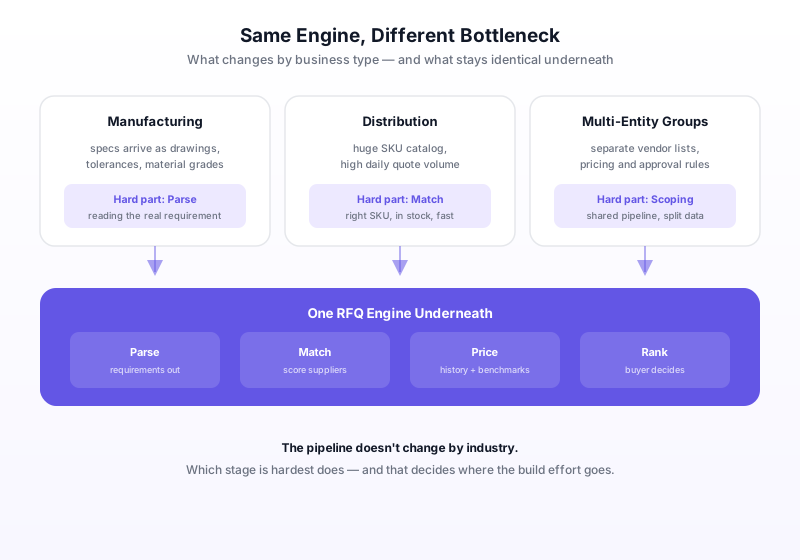
"RFQ automation" gets sold as one thing. In practice the shape of the problem changes a lot depending on what you sell, and the difference decides where the build effort — and the budget — actually goes.
The engine underneath is the same in every case: parse, match, price, rank. What differs is which of those four stages is hard. Get that diagnosis right and a build is straightforward. Get it wrong and you spend months optimising a stage that was never the bottleneck.
Manufacturing: The Requirement Is Buried in the Spec
In manufacturing procurement, the incoming request is rarely a clean list of parts. It's a drawing reference, a material grade, a tolerance stated three different ways, a finish requirement mentioned in a sentence rather than a field, and a quantity that may or may not include spares.
Getting that into structured fields is the entire difficulty. Once you genuinely know what's being asked for, matching suppliers is comparatively simple — most manufacturers work with a known shortlist of qualified vendors, not an open market. The scoring problem is small; the reading problem is large.
Practically, that means a manufacturing RFQ build spends most of its effort on extraction accuracy and on the feedback loop that improves it. Expect the first version to handle standard requests well and to miss on unusual formats, then improve as it's retrained on your real request history. That's the normal maturation curve for this kind of system, not a sign something is wrong — the first version being weak on edge cases is what the second iteration is for.
One consequence worth planning for: because tolerances and material grades carry real liability, the review step stays firmly with a qualified person. The engine narrows and prepares; it does not approve a spec interpretation on its own.
Distribution: Volume and Catalog Size Are the Problem
For a B2B distributor the requests are usually easier to read — often a part number, a quantity, and a delivery date. The difficulty is elsewhere: matching that against a catalog with tens of thousands of SKUs, checking availability, and doing it fast enough to be the first quote back.
Here speed genuinely decides revenue. In most distribution categories the buyer who responds first has a real advantage over the one who responds best, because a good-enough quote that arrives in an hour beats a marginally better one that arrives tomorrow. Automating the match-and-respond loop is not primarily a cost saving, it's a win-rate change.
That shifts what a build optimises for. Extraction can be relatively simple. What matters is matching quality across a large catalog — handling equivalents and substitutes, respecting stock reality, and not returning a technically-correct SKU that's twelve weeks out. Pricing context matters more here too, because thin distribution margins mean an unconsidered discount does real damage.
Multi-Entity Groups: Shared Pipeline, Separate Data
Groups running several business units, regions, or legal entities have a different problem entirely. Each entity typically has its own approved vendor list, its own negotiated pricing agreements, and its own approval thresholds — and those must not bleed into each other. One entity seeing another's negotiated rates can be a genuine commercial and contractual problem.
The instinct is often to build separate systems per entity. That's expensive and it means every improvement has to be made several times. The better pattern is one shared pipeline with per-entity configuration: parsing, matching logic, and ranking are common code, while vendor catalogs, pricing agreements, and approval rules stay scoped to the entity that owns them.
We use the same pattern for running multiple branded products on one codebase — everything that differs lives in configuration, and the pipeline underneath never forks. The discipline is the hard part, not the architecture: the first time an entity asks for something the config can't express, there's a strong pull to branch the code "just this once," and that's how a shared system quietly becomes several systems again.
What Doesn't Change
Three things hold across all of these, and they're worth stating because they're where projects go wrong regardless of industry:
- The data pipeline comes before the AI. Intake, storage, and processing get built first — so you stop losing quote and vendor history while the system is being built, and so there's real data to rank against when ranking arrives. Building the clever part first leaves it with nothing to learn from.
- A human still awards the contract. The engine removes the research shift in front of the decision. It does not make the decision. That boundary is what makes the output trustworthy enough to act on.
- Version one handles the common case. Coverage of the long tail comes from production data, not from a longer specification document written up front.
Working Out Which One You Are
The diagnostic question is simple: when your team quotes, where does the time actually go? If most of it is spent working out what the customer is asking for, you have a Parse problem and you're closer to the manufacturing case. If the requirement is obvious but finding the right item and confirming availability takes the time, you have a Match problem and you're closer to distribution. If the same request gets handled differently depending on which part of the business receives it, your first problem is scoping, not AI at all.
That answer determines what a build costs and how long it takes, which is why it's worth settling before anyone writes code. See how we build RFQ engines and the production case study where research time went from 30-plus minutes to under 60 seconds — or Get Expert Input on where your own time is going.
This post is part of the AI Agents Guide — from the basics to the technical depth behind agents that actually work.
Related reading
Get the next one in your inbox
One practical AI idea per week, from real client projects. No fluff, unsubscribe anytime.