Why Vibe Coded Apps Fail: The Design Step That Fast Building Skips
By Amin Rabinia · Founder, Glissando AI
Today, anyone can build an app. Claude Code, GitHub Copilot, Lovable, Base44, Google AI Studio: you describe what you want, and a working app appears on your screen the same afternoon. People call this vibe coding. You will also hear AI coding, AI-assisted coding, or building with AI coding agents. The names differ a little in how technical the person is, and they all describe the same shift: you say what you want in plain words, and the AI writes the code. I use Claude Code every day. It is a large part of how I build for clients, and I would not go back.
So this is not a post against the tools. It is about what happens when building gets this easy. Most vibe coded apps fail, whichever AI coding tool built them, and they don't fail because of the code. They fail because of everything that was supposed to happen before the code.
The code is not the problem
Start with what the tools do well. The code they write is well structured. Writing code is the thing AI is best at, and on that narrow job it now does better than people do. If your vibe coded app is failing, a cleaner rewrite of the same app will fail the same way.
What the tools changed is the speed, and the speed changed the process. Production got much faster. It also got much more shallow and unsystematic. The design step, the part where someone sits down and thinks before anything gets built, is completely gone. People jump on a computer and start building. Founders do this more than anyone, because they are excited and the tool is right there.
What comes out the other end is an app. Often it is a toy. It is not yet a product that makes money or carries a business, because there was no thoughtful process behind it.
AI coding made everyone more tactical
People are tactical by nature. We are biased toward action. Doing something today feels better than deciding where we want to be in two years, and it always has.
AI-assisted coding made that bias much worse. Every idea can become a working screen within the hour, so there is always something to do next, and the doing never has to stop for a decision. The work turns into day-to-day building. The vision and the long horizon behind the product quietly drop out.
I think this is one of the real dangers for founders right now: too much tactics, too much execution, and no direction above them. A tactical question with no strategy over it gives you random options and a product that goes in circles. That was true before these tools existed. The tools just removed the friction that used to force a pause.
It helps to see where this sits in the Startup Triangle. Every startup is three things: a founder, a market and a product. AI coding agents made the product corner fast and cheap, so that is where all the attention goes. The market corner gets no time at all. And the founder's real job, thinking about the whole thing as one system and steering it, is the part no tool does for you.
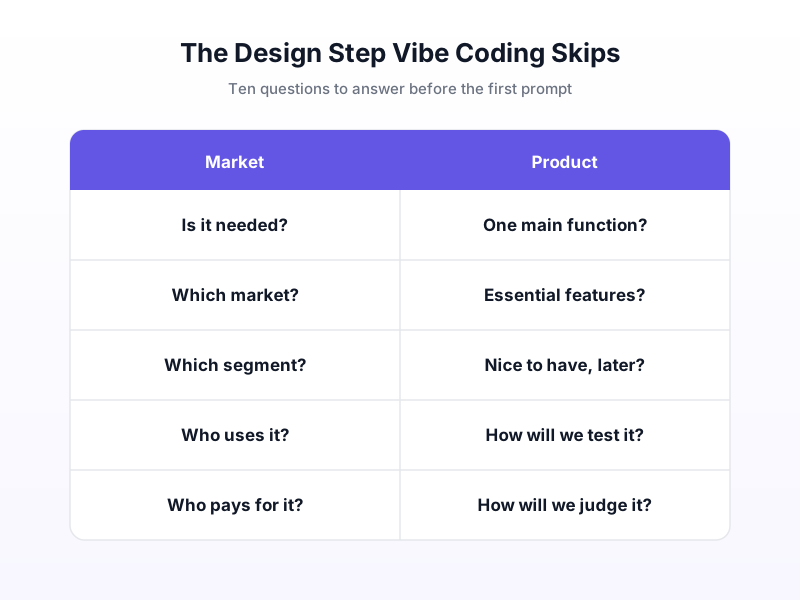
What gets skipped: two sets of questions
When I look at what is missing behind a vibe coded app, it falls into two groups.
The market questions. These get jumped over completely:
- Is this product needed at all?
- What is the market?
- Which segment of that market is it for?
- Who is the user?
- Who is the customer, the person who pays? (Often not the same person as the user.)
The product questions. These get skipped next:
- What is the one main function?
- Which features are essential to that function?
- Which are nice to have, and what is the plan for adding them later?
- How are we going to test it?
- How will we judge whether it is performing well?
None of these questions needs a computer. That is exactly why they get skipped. The tool is open, it rewards typing, and none of these can be answered by typing a prompt.
If you want the order to think in, I laid it out in the Core, Form, Market framework: pin down the core idea, then the form it takes, then how it reaches people. This post is the why. That one is the how.
Easy features, confusing products
The second thing that goes wrong happens inside the product. Because adding a feature now costs almost nothing, features get added. A dashboard, a settings page, an AI assistant in the corner, three ways to export. Each one took ten minutes, so each one seemed free.
They are not free for the person using the app. The user opens it and is faced with so many options and so many things on the page that they can't tell what it is for. The app is loaded with features nobody asked for and nobody wants to use, and it is confusing and hard to use as a result. It targets everyone and serves no one.
The code underneath can be excellent and this still happens, because it is a design problem: the workflow, how a person moves through the app, and how much is put in front of them at once. I wrote about the root of it in why function beats features, and about the design side in prompting isn't product design.
Building more features is much easier than it used to be. Building the right thing, something that sells and gives real value, is harder than it used to be.
The market is flooded, and people are tired
It is harder partly because everyone else got the same tools on the same day. There are more products than ever on your phone and on the internet: mobile apps, web apps, software subscriptions for every small task.
People have app fatigue. They download something, it doesn't solve their problem, and they delete it. After enough rounds of that, they stop being open to trying new things at all. A new app now has to earn its place against that tiredness, with a clear answer to "what is this for, and why should I bother?" An app that was never thought through can't give that answer, which is a close cousin of AI slop: plenty of output, very little meaning.
What to do before you build
For a founder who wants to do this once and get it right, the answer is to spend more on the part that feels abstract: the research and the design, before the building and the coding.
This is how I run my own MVP process. Before I design anything, and well before I build, I ask a client a lot of questions about their market and their product vision, until both make sense. Only then do we design the product, and only after that do we build it. The building is the fast part now. That is the best argument for slowing down everything that comes before it.
In practice:
- Answer the ten questions in writing. One or two sentences each. Gaps are fine. Knowing where they are is the point.
- Pick the one main function and the one main user. Everything else waits.
- Sort every feature idea into essential or later. Essential means the main function does not work without it. Most ideas land in later, and that is the right result.
- Decide how you will test it before it exists. Who will use it first, and what would they have to do or say for you to call it working?
- Then open the tool. With those decisions made, Claude Code or Lovable becomes what it should be: a very fast way to build something you have already thought through.
If you have already built the app, the same list works in reverse. Answer the questions now, and use the answers to decide what to remove. Keeping the scope on one function is also what keeps an MVP inside a $2k–$10k budget, and it is the difference between a demo that looks good and a product that holds up with real users.
When it's honest to do it yourself: if you are building a small tool for your own use, or a quick prototype to show one person an idea, go ahead and vibe code it without any of this. The questions matter when you expect strangers to pay for the result.
If you would like a second opinion on your answers before you spend money building, that is what my strategy work and Get Expert Input sessions are for. And if the thinking is done and you want to see the core working, I build a free working demo around it first.
This post is part of the Building with AI Guide, everything we've written on turning an idea into a working product.
Related reading
- How to Validate a Business Idea Before Building: The Core, Form, Market Framework
- Why Do Startups Struggle? The Startup Triangle
- Building AI Products That Work: Why Function Beats Features Every Time
- Prompting Isn't Product Design: How to Build AI-Native Experiences That Work
- How Much Does an AI MVP Cost?
Get the next one in your inbox
One practical AI idea per week, from real client projects. No fluff, unsubscribe anytime.